1-Page Summary
If you’ve turned on a TV or read a newspaper in the last two decades or so, you’d have a pretty grim picture of the world. Terrorism. Extreme poverty. Deadly epidemics. And it’s getting worse all the time. But this view is completely wrong. Not only are things much better than we think—they’re better than they’ve ever been.
Factfulness: Ten Reasons We’re Wrong About the World—And Why Things Are Better Than You Think explores our misconceptions about the world by identifying ten instincts that mistakenly lead us to embrace an over-dramatic, stereotyped, inflexible, and unduly pessimistic view of the world.
For each instinct, the book explores real-world examples of how they manifest, why we believe in them, their harmful impact, and how we can apply factfulness to overcome them. At the end of this summary, we hope you’ll have swapped out your dramatic worldview for a factful one: informed by data, relentlessly eager to absorb new information, and always questioning conventional wisdom.
The Gap Instinct
This is our tendency to divide the world into binary groups (like rich vs. poor countries, developed world vs. undeveloped world). In reality, there is a vast and highly differentiated middle-class of countries, which is where most of the world’s population lives. The Gap Instinct makes us see the world as being more fractured than it really is and inhibits international collaboration. To overcome the Gap Instinct, avoid comparing simple averages, don’t draw too much from extreme examples of wealth or poverty, and check how your own biases might be leading you to false conclusions.
The Negativity Instinct
This is the belief that the world is bad and getting worse. The instinct is false—the world is safer and richer than it’s ever been and it’s improving all the time. When we buy into the Negativity Instinct, we come to either embrace radical and drastic solutions or give in to hopelessness and despair (the latter of which encourages inaction). To avoid this, learn to expect disproportionately bad news, accept that things can be both objectively bad and still improving, and sharpen your knowledge of the past to gain a better perspective on the present.
The Straight Line Instinct
This is when we wrongly believe that trends will continue at the same rate and in the same direction forever. It results in both unnecessary panic (for example, about the sustainability of the world’s population) and the ignoring of problems that do require attention (like not helping impoverished people out of fear of contributing to population growth). To beat the instinct, increase your basic quantitative knowledge: not all statistical curves are straight lines, and you might only be seeing one small part of a larger trend.
The Fear Instinct
This is our instinct to greatly overstate the likelihood of harm coming to us, often from terrorism, war, or disease. It leads to irrationality, paranoia, and dangerous overreaction. To steer clear of this fearful mindset, remember that fear should be a function of both risk and exposure, assess the data before becoming afraid, and be skeptical of the dramatic, doom-and-gloom stories on the news.
The Size Instinct
This shows up when we assume too much based on one single incident or a solitary point of data. With only fragmentary evidence, we lose our sense of proportion: we make faulty judgements of scale, thinking things are bigger or smaller than they really are. In reality, isolated pieces of information and anecdotal evidence are poor substitutes for reliable statistical data. When we lean too heavily on small samples (and unrepresentative samples at that), we apply disproportionate focus to the wrong problems, and misallocate scarce resources. To avoid falling into this trap, apply extra scrutiny to data: instead of just accepting some isolated statistic, compare it against a larger set of data to get a better sense of proportion and perspective. Also, focus more of your attention and resources on only the largest numbers in a set of data.
The Generalization Instinct
When we generalize, we miss differences. This is especially true of those whom we consider to be different than “us.” Building on the Gap Instinct’s tendency to divide the world into binary groups, the Generalization Instinct turns the diversity of the rest of the world into a single, amorphous, and undifferentiated “them.” This ignores both the diversity within groups (like the vast income level differences between African countries) and the similarities between groups (like the common material standards of people at the same income level in different countries). When we think this way, it leads to stereotypes and ignorance about just how much the world has changed. To overcome this instinct, question your categories, avoid extreme examples, and be aware of your own biases and limited worldview.
The Destiny Instinct
This is our mistaken assumption that immutable characteristics determine the fate of nations and societies. In fact, cultures change rapidly over time. The instinct forces us to miss opportunities to invest in parts of the world that have undergone major development and shun efforts to help regions develop (since we assume they can’t change anyway). To rise above this instinct, remember that “slow change” is not “no change” and always update your knowledge about the world: what you knew to be true 10 years ago is probably out-of-date.
The Single Perspective Instinct
This is the impulse toward simple explanations for complex problems and one-size-fits-all solutions. It leads us to embrace all-encompassing ideologies and apply the wrong solutions to the wrong problems. As the old expression goes, “to someone with a hammer, every problem looks like a nail.” To apply factfulness to this instinct, seek out the opinions of people who disagree with you, don’t rely on numbers alone to form your view of the world, and avoid ideologues.
The Blame Instinct
This is when we look for a single source of blame for a given problem. Problems like war, famine, poverty, and discrimination, however, arise from multiple, complex sources. Rarely is an individual person or single factor responsible: instead, broader political and economic forces shape our world. When we lean into the Blame Instinct, we ignore the broader context in which events happen, focus only on symptoms of problems, and scapegoat the wrong people. To avoid this pitfall, look for causes instead of villains and study systems instead of individual heroes.
The Urgency Instinct
This is the “now or never” instinct: to avert catastrophe, we must act immediately and drastically. Rarely is this a good strategy for solving global problems, however. It leads to rash overreactions, panic, unintended consequences, and a loss of credibility when we overstate the severity or urgency of problems. Instead of doing this, we should insist on the data, take worst-case-scenario predictions with a dose of skepticism, and accept that the future is uncertain before we commit to action.
Conclusion: Opening Your Eyes to the World (As It Really Is)
By identifying and overcoming these instincts, you will transition from having a pessimistic and dramatic worldview to having one that is based on facts and reason. Shedding these instincts doesn’t make you a wide-eyed, naive optimist: it makes you a possibilist. You will be convinced of humankind’s possibilities for growth and progress based on the evidence of the enormous strides we’ve already made. And hopefully, you will learn not to hope without reason, but also not fear without cause.
1: The Gap Instinct
The gap instinct is the tendency to divide the world into binary groups, with vast chasms between the two. Think of the simple categories we hear all the time when we discuss global economic development or worldwide standards of living. Rich vs. poor. The developed world and the undeveloped world. The West and “the rest.”
We are deeply conditioned to see the world this way. Yet the data shows that these gaps don’t really exist. There is instead a vast middle income level separating extremes of wealth and poverty. As we’ll see, extreme poverty is rapidly declining in all corners of the globe. In fact, 5 billion of the world’s roughly 7 billion people now live in middle-income countries.
The Four Levels
What do we mean by “middle-income countries?” Well, first we should revise our whole framework of “developing countries,” and “developed countries.” It’s more useful and accurate to think of countries as being along a range of income levels.
- Level 1: People at this level subsist on less than $2 per day. They lack access to basic medical care, clean drinking water, and survive on subsistence farming. This is extreme poverty (1 billion people).
- Level 2: People at this level earn between $4 and $8 per day. They are able to purchase some food that they did not grow themselves, can afford some medicines, and have moderate access to electricity (3 billion people).
- Level 3: People at this level earn between $8 and $32 per day. They are able to accumulate some savings, can afford access to running water, refrigerated food, and basic education for their children (2 billion people).
- Level 4: People at this level earn over $32 per day (if you’re reading this summary, you’re likely at this level). These are rich consumers who can afford luxuries like higher education, airfare, automobiles, and frequent visits to restaurants (1 billion people).
As this range shows (and as we mentioned above), the majority of the world’s population lives at Levels 2 and 3. If you go a step further and combine the middle and high-income countries, we see that only 9 percent of people live in extreme poverty. This is lower than at any time in human history.
Delusions of Distance
Despite this, people in Level 4 countries are deeply ignorant of how the rest of the world lives. They believe that the gap between their standard of living and that of the rest of the world is far greater than it actually is. For example:
- Only 36 percent of Americans know that the majority lives in middle-income countries.
- Only 9 percent of Germans correctly guessed the percentage of girls in low-income countries who finish primary school (the correct answer is 60 percent).
This pattern of ignorance among people at Level 4 is profound. Whether you’re looking at life expectancy, child mortality, or vaccination rates, citizens of wealthier countries consistently believe in this vast chasm between themselves and the rest of the world.
Causes of the Gap Instinct
Why do we believe that we’re all so different from one another?
The answer lies in our tendency toward a dramatic, binary worldview. Look, we live in a complicated world, far more complex and diverse than the ones our ancestors lived in. We’re bombarded with new information all the time and the rate of social and economic change can be disorienting. In light of this, you can see why the Gap Instinct exerts such a powerful hold: it makes processing all of this information far easier by reducing the sometimes-frightening complexity of the world to simple dichotomies.
Journalists and activists also portray the world this way: Political debates and news headlines revolve around themes like the 1% versus the 99%.Giant global corporations vs. small mom-and-pops. This is a theme we’ll revisit throughout, but it’s true: dramatic, divisive, conflict-driven stories make for more compelling newspaper articles and television clips.
Problems Arising From the Gap Instinct
The Gap Instinct has a harmful impact on the real world.
In the main, it inhibits the very sort of international and cross-cultural cooperation we need in order to address global problems. When we see the world so divided into groups, with no overlap and no possibility of bridging the gap, it becomes very hard to work together.
It also gets in the way of basic human empathy. Psychologically, we are naturally empathetic toward those we see as being similar to us. The Gap Instinct short-circuits this empathy by making us believe that we have less in common than we actually do.
Overcoming the Gap Instinct
To avoid succumbing to the Gap Instinct, read reported statistics more closely and look for the (often hidden) majority behind the headline numbers.
Be Careful With Comparing Averages
Comparing two averages is an overly simplistic way to analyze data. By only focusing on the means, you’re ignoring the overlapping spreads and the overlapping range of numbers that are shared by the two datasets. For example, the average income per day in the US ($67) vs. Mexico ($11) overlooks the broad income overlap between individuals in these countries: all Americans are not richer than all Mexicans.
Remember also that averages are easily distorted by a few outliers ( Bill Gates and someone with $0 have an average net worth of $50 billion). At best, they’re a crude measurement when applied to broad statistical categories like the ones we’re talking about.
Look Past the Extremes
There will always be extremes of wealth and poverty. Inordinate focus on them obscures the fact that most people live in the middle.
For example, the richest 10 percent of Brazilians have 41 percent of the country’s wealth. That sure seems like an extreme concentration of wealth. However, this statistic ignores the fact that this elite controlled 50 percent just a generation ago. Income is much more evenly spread out in Brazil now: today, the vast majority of Brazilians are at Levels 2 and 3.
Be Aware Of Your Own Perspective
At Level 4, we lack perspective on life at the other levels and are misled by media representations of the rest of the world. This is especially true when you consider that most members of the media themselves are at Level 4, so those biases are baked into their coverage.
We can’t change media biases, but we can scrutinize our own biases. Ask yourself, “Am I really normal? Is my experience typical? What might be the blind spots in my view of the world?” Having some basic humility like this will allow you to open your mind to the true variety and diversity of the world.
2: The Negativity Instinct
The negativity instinct is the tendency to believe that the world is bad and getting worse. You might fret about the looming threat of global warning, the frequency of terrorist and shooting attacks, and the ever-uncertain condition of the economy.
A factful worldview, however, demonstrates that this is not the case. Across a variety of standard of living measurements, the state of the world is better than it’s ever been.
Extreme poverty (Level 1) has halved over the past 20 years. This rate of progress is remarkable when you consider that nearly all of humanity lived this way for most of recorded history until very recently: a full 85 percent of the world’s population was at Level 1 in 1800, 50 percent did as recently as 1966 (well within the living memory of billions of people alive today).
Global average life expectancy has risen to 72: it was 30 at the dawn of the Industrial Revolution in 1800. This positive trend has been driven by another positive trend, namely the drastic decline in infant mortality.
Even today’s poorest Level 1 countries like Lesotho or Zambia enjoy a better standard of living than today’s Level 4 countries like Sweden or the United States did only a few generations ago.
A World of Improvements
A combination of a decline in bad trends and an increase in positive trends has made the present the best time to be alive in human history.
Just take a look at some of the bad trends that have declined:
- Slavery: Once a near-universal institution, it’s only legal in three countires today.
- HIV: Rates of infection per million are half of what they were in 1996.
- Child mortality: A shocking 44 percent of children died before their fifth birthday in 1800. Today this figure has been whittled down to 4 percent.
- Combat deaths: At the height of World War Two, there were 200 combat deaths per 100,000 people. Today that number is 1, even with the ongoing Syrian Civil War.
- Hunger: 28 percent of people worldwide were malnourished in 1970. Today, that figure is 11 percent.
And as a corollary, check out these good trends that are on the rise:
- Women’s suffrage: At the dawn of the 20th century, almost no countries allowed women to vote. Today, 193 out of 194 do.
- Food production: Crop yields have nearly quadrupled since 1961. This has been a major driver of the aforementioned decline in worldwide hunger.
- Access to electricity: The share of people with access to electricity increased from 72 to 85 percent from 1991 to 2014.
- Access to clean drinking water: More people than ever can drink safe, treated water, with that figure going up 30 percent from 1980 to 2015.
Causes of the Negativity Instinct
With things so clearly improving, why are we so prone to negativity? Why don’t we see the progress that’s happening all around us?
Nostalgia
We are misinformed by nostalgia. We exalt the past as being a better time whose standards and values we’ve forsaken. And we usually attribute today’s problems to the abandonment of those values. But this is flatly wrong.
But this is flatly wrong. In fact, by most statistical measures, earlier historical periods were always worse than the present day. For example, India’s material standard of living (even in remote rural areas) increased greatly from the 1970s to the 1990s as the country progressed from Level 1 extreme poverty to Level 3 middle-income status. When the Swedish author Lasse Berg travelled to India in the 1990s, he showed the residents of a remote village pictures of their community during the 1970s. They were incredulous: how could the recent past, a time they thought they remembered so well, be so starkly different from the images in their heads?
Or consider ancient graveyards. For all our fascination with and admiration for these civilizations, antiquity was a pretty grim time to be alive: their graveyards display levels of infant and child mortality that would be unfathomable today.
Selective reporting
Journalists, activists, and politicians are storytellers and they have a bias toward a dramatic and negative worldview. With the Internet, we have more access to information than ever. This makes us more aware of human suffering, causing us to think that it is pervasive and on the rise. But we’re only becoming aware of things that were always happening. And as we’ve seen, the bad trends we read about are on the decline.
Overuse of Intuition
We tend to form conclusions based on our intuition or our gut, rather than using the reasoning powers of the human mind or the vast quantities of trustworthy data we have at our disposal.
This makes some sense. After all, we evolved from creatures whose survival instincts were based on intuition, quick judgements, and a reliance on what their eyes and ears told them. This benefited early humans who lived in relatively small, close-knit communities that consisted mostly of kin. They didn’t have to grapple with data. Thinking too much, in fact, could get you killed.
As we’ll see with some of the other instincts, this mindset is totally unsuitable for the modern world. Today, you need data and analytical tools to make sense of the reams of information you have to process. You need more than just your gut to separate the signal from the noise.
Problems Arising from the Negativity Instinct
The Negativity Instinct can and does cause real harm.
We become more willing to embrace radical and urgent solutions to problems if we believe the world is in a dire state. These solutions tend to cause more harm than good, because no one bothers to think through their full ramifications.
The Negativity Instinct also causes a loss of hope and an abandonment of efforts to improve things. If you think things are so bad, you’ll eventually start thinking that things are bad beyond redemption. You are simply overwhelmed by your mistaken ideas of how dire things are. Once you believe that, there’s no incentive to improve things, since they’ll never get better anyway. It’s a vicious cycle: misplaced negativity leads to apathy, which leads to more suffering, which leads to more apathy. This is a tragic loss, because there still is poverty and suffering that demands attention.
Overcoming the Negativity Instinct
How do we avoid falling into a pessimistic (and false) view of the world? By managing our expectations about the news we read and bringing some nuance and perspective to our understanding.
Bad and Improving: Not Mutually Exclusive
Things can be both improving and still objectively bad. You’ll come to the wrong conclusions if you only look at a bad situation without considering the broader context.
Ask yourself: “Is this bad situation better than what it used to be? Is it bad compared to other examples of the same phenomenon? Is it improving?”
Think of a baby in the NICU. Obviously, any baby needing intensive care is terrible. And that baby is certainly in objectively poor health at any given point in time. This doesn’t mean, however, that the baby’s health isn’t better today than it was yesterday or the week before.
Price In the Bad News
It’s just reality: negative news is repeated and shared in the news media, while positive news isn’t. This is because bad news is a better fit for the dramatic worldview: it’s sudden and its consequences are felt immediately.
Good news, meanwhile, usually entails the gradual improvement of basic conditions over very long periods of time. Which do you think makes a better headline:: “Plane Crash Kills 300” or “Extreme Poverty Halves Over 20 Years”?
Don’t Censor History:
Don’t romanticize the past and don’t fall prey to the historical amnesia we discussed above. For much of human history, people’s lives were “nasty, brutish, and short,” to quote the English philosopher Thomas Hobbes. You miss the forest for the trees when you overlook the extraordinary progress that society has made.
3: The Straight Line Instinct
The Straight Line Instinct is the tendency to believe that trends will continue at their current rate forever. Data and some common sense demonstrate that this is not the case:
For example, a child might grow over 35 percent in their first six months after birth, but they obviously don’t continue at this rate for the rest of their lives (otherwise, we would see a lot more seven-foot tall five-year-olds)!
The Straight Line Instinct is the cause of a lot of misplaced pessimism, particularly with regards to world population growth. Magazines, newspapers, and pundits warn of an unsustainable growth in population that will diminish the planet’s food supplies, push climate change past the point of no return, and spark human conflicts as different groups compete for ever-shrinking resources.
(Shortform note: This isn’t a new source of fear. In his 1798 book An Essay on the Principle of Population, the English scholar Thomas Malthus warned that a similar population explosion threatened to doom his generation to poverty and immiseration. Based on what you’ve already learned in this summary, you know that this didn’t happen.)
The idea is widely accepted: 85 percent of surveyed “experts” in Level 4 countries overestimated population growth. And, sure, if you looked at a graph like this, you might be seriously alarmed:
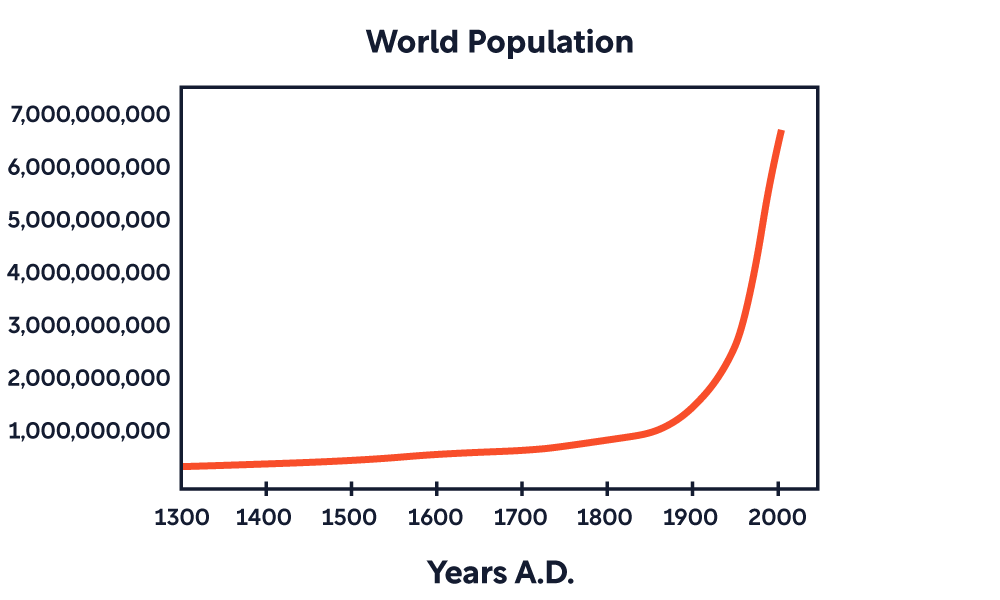
It looks like population is just exponentially growing with no end in sight! Once again, however, popular belief is wrong: population growth is projected to begin levelling off as we approach the end of the 21st century. In fact, the number of children in the world in 2100 is projected to be the same as today.
A Population Explosion? Think Again
The world’s population is increasing: but it’s not increasing exponentially and the rate has already begun slowing down. World population will settle between 10 and 12 billion by 2100, a figure far lower than a straight line projection from today’s figure of 7.6 billion would have you believe.
Why will population slow down? Because the number of children will stay flat. One of the benefits of people moving out of Level 1 is that they have fewer children: and indeed, the worldwide average number of babies per woman has halved over the past 50 years. This is because people at Levels 2 and 3 (remember, this is where most of the population now lives) have better access to contraception and less of a need to have children since they don’t need more hands for subsistence agriculture.
As more people leave Level 1 for Levels 2,3, and 4, this will only continue. The trend then starts to become self-sustaining: the new generation of people born at higher income levels will have fewer children than the generation that preceded them. The expected, modest increase in population will come from these children and young adults today growing up and becoming the middle-aged and elderly of the future: there will simply be more adults.
It’s useful to put population in some historical context. World population was approximately 5 million during the prehistoric era and stayed flat throughout antiquity and well into the modern era, due to high rates of child mortality. It only reached 1 billion around 1800 as the Industrial Revolution was dawning. Today’s population is around 7.6 billion. The majority of the increase has come only since the mid-20th century.
How the rate of increase is slowing is itself a cause for optimism. People are choosing to have fewer children because they’re rising out of poverty, gaining new economic opportunities, and for women, gaining autonomy of their reproductive choices. It’s a process driven by choice. Contrast that with how population has been held in check for most of human history: child mortality, epidemics, and famine. The new population equilibrium is much better than the old one.
Causes of the Straight Line Instinct
Why do we continue to believe that things will keep moving in the same direction and at the same rate that they are now?
Like many of these instincts, the Straight Line Instinct is a cognitive inheritance from our prehistoric ancestors. For our Neanderthal forebears, it would have been a handy survival tool, telling you that the projectile headed your way would continue on that trajectory until it smashed into your face. This form of visual forecasting probably played a key role in natural selection: that’s why we have the instinct today. Unfortunately, it’s a poor tool for the complexity and nuance of the modern world.
Problems Arising From the Straight Line Instinct
The Straight Line Instinct, when applied specifically to the problem of overpopulation, does real harm to global welfare. If you believe that exponentially growing population is hurtling the planet toward a sustainability crisis, then you would be opposed to investing in healthcare and education services around the world. After all, wouldn’t doing so only exacerbate the problem of overpopulation?
Of course, we’ve learned that the answer to this question is “no.” Lifting people out of poverty is the humane thing to do on its own merits and actually alleviates population growth by bringing people into Levels 2,3, and 4, making them likely to have fewer children. Unjustified fears of overpopulation have always been used to justify regressive and harmful social policy.
Overcoming the Instinct
It’s useful to remember that statistical trends follow many different types of curves, not just a straight line. As people move from Level 1 to Level 4, these trends follow different patterns.
S-Bends
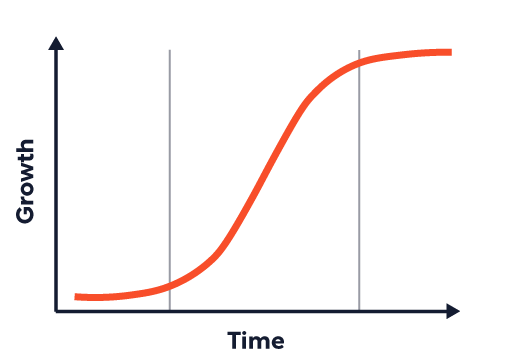
These curves are low and flat at Level 1, rise sharply at Level 2, and flatten off at Levels 3 and 4. Trends that follow this type of curve include female literacy, vaccination rates, and refrigeration. This is because once people reach Level 2 they can afford these luxuries and start consuming them en masse. But the increase slows down in Levels 3 and 4 because everybody already has them by then.
Slide Curves
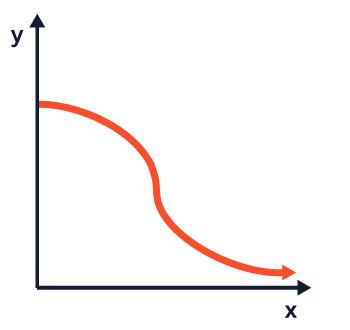
These curves are the inverse of S-Bends: flat at Level 1, a sharp decrease at Level 2, and then a flattening at Levels 3 and 4. A significant example of a phenomenon that follows a slide curve is babies-per-woman. Women have fewer kids as they get more access to contraception and escape extreme poverty in the transition from Level 1 to Level 2. But children born at Levels 3 and 4 are less likely to have fewer kids, so the rate of decrease drops.
Hump Curves
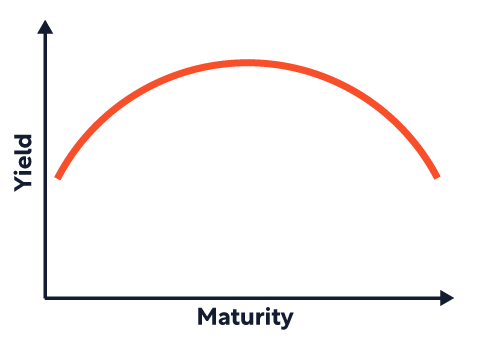
Hump curves are low at Level 1, rise sharply at Levels 2 and 3, and decline again at Level 4.An interesting example of a trend that moves along a hump curve is cavities. People can’t afford sweets at Level 1, so they have fewer cavities. As they get richer, they can start to afford candy and soda, but not dental care, so cavities peak at Levels 2 and 3. By Level 4, however, people are wealthy enough to afford adequate dental care, so cavities decline once again.
Doubling Curves
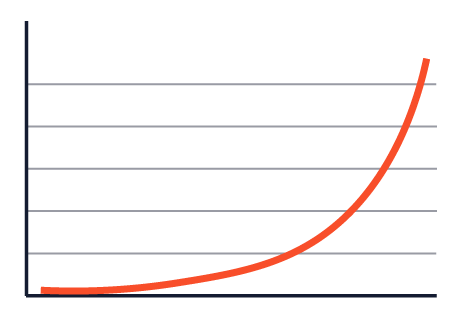
This type of curve shows an exponential increase from Level 1 to Level 4. Examples include distance, spending, and CO2 emissions. The reason is that all of these are directly correlated with income. The more money you have, the more you will travel, spend, and contribute to emissions. However, the effect of money is different at all levels: the marginal increase of $1 is life-changing at Level 1, but fairly meaningless at Level 4.
See the Big Picture
Always remember to ask when you’re shown a trend: which part of the curve are you seeing?
The straight line you’re seeing could be just one small part of a trend that’s actually an S-Bend, slide curve, hump curve, or doubling curve.
Exercise: Question Your Assumptions
Work through these questions to see how the instincts might be misleading you.
Have you ever been surprised by learning how much you have in common with someone from another culture? Describe the experience.
Can you think of a negative misconception you once held that turned out not to be true? How can you change your thinking in the future to avoid this?
Can you describe a real-world example of a statistical trend that didn’t follow a straight line? Explain why you think it followed this course.
4: The Fear Instinct
The Fear Instinct is the tendency toward overblown and misplaced fear. It manifests most commonly with fears of physical harm (like murder, natural disasters, plane crashes) or contamination (from either poisoning or disease).
Living in our world, you’d certainly be forgiven if you lived in a state of perpetual fear. Stories about plane crashes, terrorist attacks, mass shootings, and deadly outbreaks of disease dominate news coverage.
(Shortform note: The drumbeat of fear isn’t just in your head. Data scientist Kalev Leetaru used sentiment mining of every New York Times article published between 1945 and 2005 to determine that news coverage really has gotten more gloomy and negative since the 1970s.)
People consistently overestimate the incidence and likelihood of danger. But the data shows that such fears have little rational basis (and are less likely to happen to you now than they’ve ever been in history).
For example, even at Level 1, disasters kill less than half the number of people than they did in 1990. In fact, deaths-per million from disasters were over 450 during the 1930s: that number was 4 in 2016).
The World is (Not) Terrifying
Some quick statistics show that the world is not the scary place we imagine it to be. Better international cooperation combined with stronger rulemaking and regulatory bodies have alleviated a great deal of human suffering. Let’s take a look at a few examples to see how safe the world has actually become.
During the 1940s, Bangladesh was a poverty-stricken Level 1 country that suffered catastrophic droughts, flooding, and famine, resulting in 2 million deaths in that decade. But because of economic development, the country is now at Level 2. This has enabled it to invest in better government, civil institutions, and infrastructure. When the 2015 cyclone hit, the government had an efficient system to evacuate refugees from the flood zone and provide over 30,000 people with food (with an assist from the World Food Programme).
Plane crashes are a recurrent source of fear (and receive wall-to-wall media attention when they do happen). There were 2,100 deaths per billion passenger miles at the dawn of the Aviation Era in 1929-1933. Today, that figure is virtually zero: 99.999975 percent of commercial flights landed safely in 2016 (in other words, only 10 crashes out of 40 million flights). This is partially a result of better international cooperation: the 1944 Chicago Convention created rules around aviation safety and a common accident report so pilots, airlines, and governments could learn from crashes.
We all know war is terrible and the media often portrays a world engulfed in conflict. It’s true that warfare has been a constant since the dawn of human history (there’s never been a time where there wasn’t some armed conflict going on somewhere). But some historical context brings things into perspective. 65 million people died in World War Two. Contrast that with the Syrian Civil War, the bloodiest conflict going on today, whose death tolls pale in comparison with those from earlier conflicts. Even if its death toll reaches 200,000, that is a shadow of the figures from conflicts as recent as the Iran-Iraq War of the 1980s. Remember this: there were 2,013 combat deaths per million people in 1942, against 12 in 2016.
Causes of the Fear Instinct
Why are we so fearful about the world?
Tendency to Drama
Fear was a useful thing for our ancestors, whose primitive circumstances really did make the world a scary and dangerous place (you could easily be killed by wild animals, suffer one bad harvest and starve, or be captured and imprisoned by warlike neighbors).
Like so many evolutionary instincts, this one is obsolete and leads us to form misconceptions about the world.
Media Bias
Stories that provoke fear are an easy way for media outlets to capture viewer attention.
This is especially true in a 24-hour news cycle where consumers can instantaneously choose between a wide variety of media outlets and hyping fear and drama become the main bases for competition. Hence the attention on sudden, dramatic, and scary events like earthquakes, building collapses, terrorist attacks, and plane crashes.
Problems Arising from the Fear Instinct
The Fear Instinct is highly damaging, causing irrationality and paranoia. There is no room for facts and cool analysis when our minds are overwhelmed by fear.
As a result, we overestimate dramatic events that are highly unlikely. For example, terrorism deaths are almost non-existent in rich Level 4 countries, under 1,500 from 2007 to 2016. Compare that with the 69000 people per year killed by alcohol during that same period in the United States alone.
The risks we fear the most are actually those that cause the least harm. Our overreactions often cause more harm than the things that generate them. Consider how anti-vaccination movements lead to outbreaks of long-eradicated diseases. Or how anti-DDT campaigns (born of chemophobia, an irrational fear of chemicals) hurts efforts to combat malaria.
Overcoming the Fear Instinct
Always remember to calculate the risks and incorporate facts into your worldview to avoid falling into the fear trap:
Fear Is A Formula
Fear = risk x exposure. You should always think about the likelihood of something happening to you before being afraid of it. Yes, terrorism and earthquakes are scary and it would be terrible to fall victim to either: you also have an incredibly low chance of dying from them. They are frightening, but not dangerous.
Take A Breath
You’ll never make wise decisions in a state of panic. Assess the data before committing to a fearful and dramatic worldview (and a fear-based solution). Ask yourself, “Is this thing I fear likely to happen? Has it gotten more or less likely over time?”
Take the Media With A (Large) Grain of Salt
Remember that both our brains and our media ecosystem gravitate toward dramatic and scary stories about the world. As we’ve seen, these are usually based in inflated risk calculations and/or outdated information about the prevalence or likelihood of some disastrous event. Apply a skeptical filter to the doom-and-gloom stories in the news.
5: The Size Instinct
The Size Instinct is the mistaken impulse to overestimate the importance of any single data point or incident, without putting it in the proper context (like how the data has changed over time). Combined with the Negativity Instinct, it severely distorts our worldview.
For example, 940,000 people died of HIV/AIDS-related illnesses in 2017, according to the World Health Organization. That statistic, when viewed in isolation, is certainly horrifying: 940,000 is a lot of people!
But your perception of the situation would probably change a lot if we told you that this figure was 1.9 million back in 2004 (the peak year for AIDS deaths). This means there has been a 51 percent decrease in AIDS deaths in less than two decades: something you would have completely missed if you had only looked at that one 2017 statistic. This is the Size Instinct in action.
Focusing on the Small Picture
The Size Instinct causes us to misjudge reality and devote disproportionate attention (and resources) to small details and to the symptoms of problems, rather than to large problems and their deeper root causes.
In 2016, 4.2 million babies died before the age of 1, according to the latest UNICEF data.
Obviously, that’s objectively awful: one case of infant mortality is one too many. But focusing solely on this figure causes us to lose perspective. In 1950, the number was 14.4 million, and the population of the world was much smaller. This means that both the absolute and relative number of infant deaths was far higher.
Or take a look at bear attacks. These freak events certainly are horrifying when they occur. A fatal bear attack in Sweden in 2004 received wall-to-wall coverage. But this inordinate focus on one incident obscured a crucial fact: this was the country’s first bear attack since 1902! The Size Instinct just made them seem far more likely and dangerous than they actually were.
Swine flu has generated a lot of panic, particularly in the media in Level 4 countries. During a two-week period in 2009, the disease killed 31 people worldwide. During that same period, 253,442 articles were written about swine flu: over 8,000 articles per death! Meanwhile, over 63,000 died of tuberculosis, mostly in level 1 and Level 2 countries, but swine flu received 82,000 times the coverage.
The Size Instinct was at work in all of these examples: the focus on a relative handful of extreme cases caused the world to overlook the bigger picture.
Causes Of the Size Instinct
Why do we focus so much attention on single incidents and isolated data points?
Human Compassion
When we hear a story about a dead child or a freak event that resulted in a death, it is natural for us to feel compassion and devote attention to the story. We have a bias toward things that we can see and feel: when we see one instance of suffering, we extrapolate that to form our view of the broader world. Again, this is an evolutionary inheritance: our hunter-gatherer ancestors weren’t data-crunchers. Instead, they had to make quick decisions based on conditions right in front of them. Anecdotal, one-off examples were all they had.
Storytelling
Journalists are drawn to the soft-focus, human interest story. It makes a more compelling narrative (since journalists are storytellers and we all seek to create stories and meaning out of the world around us) to focus on a single story of human suffering, with identifiable “characters.” It’s harder to make a five-minute news segment about impersonal data points or long trends changing over time.
Problems Arising from the Size Instinct
The Size Instinct, driven by our basic sense of compassion, ironically contributes to human suffering.
Disproportionate Focus
As mentioned above the Size Instinct causes us to overestimate relatively minor sources of suffering (like swine flu) at the expense of widespread causes of suffering and death. For all of the attention devoted to terrorism, simple diarrhea is a much greater source of danger, killing over 2,000 children in Level 1 and 2 countries daily (more than AIDS, malaria, and measles combined).
Misallocation of Resources
When you focus on limited data, you will make unproductive decisions with resources of money and personnel that actually hurt people. Opening fancy new hospitals to combat child mortality in places like Mozambique is only addressing a fraction of the problem (since most kids won’t even get to the hospital). The better solution would be to take a holistic approach to the problem by investing in education, clean drinking water, infrastructure, and community health workers to improve community health standards before children need to go to the hospital.
When you’re dealing with Level 1 extreme poverty, cost-effectiveness (avoiding the Size Instinct) is compassion. It’s inhumane to be inefficient.
Overcoming the Size Instinct
To steer clear of the Size Instinct, compare and divide the numbers you’re given, and always make sure to get the whole picture.
Compare Numbers
Never accept a statistic in isolation. Like the child mortality numbers or the bear attacks above, always place it in proper context: Ask yourself, “Has the frequency of this phenomenon changed over time? Is this incident or figure truly representative, or is it an outlier?”
Divide Numbers
Divide the number by a total to get a better sense of proportion and perspective. This method helps you understand the relationship of the part to the whole.
For example: with the 4.2 million infant deaths in 2016 vs. 14.4 million in 1950, dividing gives us an even greater idea of the scale of change:
14.4 million / 97 million (the total number of babies born in 1950) = 15 percent.
4.2 million / 141 million (the total number of babies born in 2016) = 3 percent. The rate declined by 80 percent during this time.
The 80/20 Rule
In most datasets, 80 percent of the results come from 20 percent of the causes (this is also known as the Pareto Principle). This rule applies to a variety of datasets, including causes of death, line items in a budget, and energy sources. A few big-ticket items are responsible for the vast majority of the effects. Knowing this, you should look for the largest numbers in a dataset to figure out which are the most important and the ones most deserving of attention.
6: The Generalization Instinct
The Generalization Instinct is the tendency to sort our information about the world into categories.
Wrong generalizations can lead us to form an inaccurate worldview. This can either be grouping things together that don’t belong or ignoring differences within groups by assuming that every item within a category is identical.
(Shortform example: We all have our preconceived notions about groups of people that we perceive as being different from ourselves. When most Westerners think of Iran, for example, we think of a backwards, traditionalistic society dominated by patriarchal fundamentalist Islamic values. We also believe that they reflexively hate the West and the United States in particular.
But this is simply a sweeping generalization. According to Business Insider:
- Iran has the world’s second-highest number of sex changes, with the government subsidizing half the cost.
- 60 percent of university students in Iran are women.
- Iranian women have the right to vote, drive, and travel alone.
- Iranians have the second-most favorable view of Americans of any country in the Middle East (second only to Israel in this category).
All of this is totally at odds with the generalized view we have of Iran. Our misconceptions come from lumping the entire country into one category through the Generalization Instinct.)
“Us” and “Them”? It’s a Bit More Complicated
People in Level 4 countries tend to lump Level 1, 2, and 3 countries together, ignoring the vast differences both between and within those categories. Take a look at some of these generalizations that well-educated people at Level 4 have about the other levels.
85 percent of managers from the world’s largest banks believe that most children worldwide were unvaccinated. As we’ve learned, the real vaccination rate is close to 90. The bank managers believe this because they have formed an inaccurate and outdated categorization of the world outside of Level 4.
As another example, Level 4 business leaders do not realize that family sizes are decreasing all across the world as people move out of extreme Level 1 poverty into the more comfortable Levels 2 and 3. This means that women are menstruating more (since menstruation pauses for about two years during each pregnancy), creating a growing market for menstrual pads and other products in these countries. But with a distorted worldview caused by the Generalization Instinct, businesses will fail to capitalize on this opportunity.
Causes of the Generalization Instinct
Why do we group the world into simplified categories?
Organize Information
The world is complicated and messy, with lots of information. We need categories to help us process the information we are faced with every day: we would simply not be able to function if we saw every item and scenario as unique.
Survival Instinct
There is also an evolutionary basis: our ancestors did not have time to take a nuanced view of the world. They had to make quick decisions for basic survival, for which generalizations were extremely useful (don’t eat plants of that color because they’re poisonous, avoid going in the tall grass where the dangerous animals are).
Problems Arising From the Generalization Instinct
The Generalization Instinct distorts our view of the world and causes real damage.
Missed Opportunities
By making wrong generalizations about the world based on outdated stereotypes, we lose sight of how much things have changed. A division of the world into “the West and the rest” blinds us as to how much difference there is within “the rest” and how similar much of “the rest” is to “the West.”
We mentioned above the lost opportunities to sell feminine hygiene products in Level 1 and 2 countries. This comes from a blend of the Generalization and Negativity Instincts. Business managers are unaware of just how different these societies are from what they imagine them to be.
Prejudice and Discrimination
All major forms of prejudice (such as racism, sexism, homophobia, and xenophobia) are products of the Generalization Instinct. When we generalize and see people as an undifferentiated mass, it’s a short step to denying them the basic respect that everyone deserves.
Overcoming the Generalization Instinct
To avoid falling into the generalization trap, reexamine and question your existing categories.
Re-think Your Categories
Photos of material living standards at different income levels across the world show that our categories (like nationality, race, and religion) lead us to wrong assumptions. Income is the main differentiating factor in determining how people live. People at the same income level across cultures and national borders share broadly similar material standards of living. Check out the Dollar Street tool at gapminder.org to see over 30,000 photos from over 250 families from 50 countries around the world, sorted by income.
Look for differences within groups (like the different individual income levels within a Level 4 country, or the vastly different income levels within the general category of “African countries”). Also, look for similarities across groups (like the shared living standards of people at the same income level in different countries).
Avoid the “Majority” Misconception
“Majority” is a very broad term—it could mean anywhere from 51 percent to 99 percent.
For example, in every country, a majority of women report that their contraceptive needs are being met. But there’s a wide variety in the size of this majority ranging from 63 percent (Angola) to France (96 percent). Always ask for the actual percentage.
Watch Out For Extreme Examples
As with the Size Instinct above, it can be dangerous to draw broad conclusions about a population based on extreme or vivid examples. There have certainly been cases of artificial chemicals causing harm. This doesn’t mean that there’s any rational basis for chemophobia
A good test to see if you’re succumbing to a bias is to ask yourself if you’d draw the same generalization from an extreme example that pointed in the other direction (i.e., concluding that all chemicals were safe because a few of them had positive effects?) If the answer is “no,” then you’re probably making an unreasonable generalization.
Don’t Think You’re “Normal”
Don’t think that your Level 4 standards and values are universal. When you encounter differences in other cultures or at other income levels, there is often a good reason for them.
The book gives an example showing photos of half-built houses in Tunisia. To our Level 4 standards, this looks confusing and decrepit - why wouldn’t you just finish the house? Are Tunisians just bad planners or irresponsible? But this isn’t the case. Without access to banking services, it is rational for Tunisians to invest their savings in bricks (which won’t lose their value) and build their houses piecemeal as they acquire more capital.
What’s True For One Group May Not Be Universal
The practice of putting unconscious adults on their stomachs helped save millions of lives by keeping their airways open. But the same practice proved lethal when it was applied to infants (hence the modern campaign to put infants to sleep on their backs). The lesson: don’t generalize from one group to another.
Exercise: Getting the Full Picture
Work through these exercises to help you see what’s really going on.
Can you think of a recent phenomenon or trend in the news that generated a lot of unnecessary fear? Describe the situation and how you can avoid succumbing to panic in future situations.
Have you ever made a wrong decision because you only had incomplete data? How can you make better decisions after reading this summary?
Can you think of a stereotype that you once believed? What caused you to accept this generalization, and how can you adjust your thinking to avoid this going forward?
7: The Destiny Instinct
The Destiny Instinct is the belief that innate and immutable characteristics determine the destinies of whole nations and cultures.
A common example of this is the idea that African culture is “backward,” and will never change or progress. It reinforces the Generalization Instinct, the Gap Instinct, and the Negativity Instinct to make people in Level 4 countries believe that human existence is the same for all people in all countries at Levels 1, 2, and 3; that these cultures sit on the other side of an unbridgeable gap from us; and that life in these places is bad, getting worse, and will never improve.
Yet, once again, the data shows that this belief in inevitability is not just pessimistic: it is totally at odds with history and reality. No society has ever stood still. 100 years ago, the US had a manufacturing economy and featured widespread legal racial discrimination; today, it is overwhelmingly a service-based economy that can elect (and reelect) an African-American man to the Presidency.
Everywhere we look across the planet, traditional, patriarchal societies are undergoing massive social and economic change. These changes are reorienting their relationships with the rest of the world.
Societies and Cultures Change Over Time
No individual is static and unchanging throughout the course of their life. The same is true for entire societies and cultures: values, norms, and material standards of living change, often much faster than we think.
It’s true that Africa as a whole lags behind other parts of the world (life expectancy is 65 there, 17 years less than Western Europe). But this obscures enormous differences both within and between African countries. All 50 nations of sub-Saharan Africa have expanded access to education, clean drinking water, electricity, and sanitation since decolonization. And they’ve done it at the same rate as European nations when they started developing during the Industrial Revolution.
In China, India, and South Korea, billions have escaped extreme poverty in just half a century, giving the lie to claims that they could never feed 4 billion people. 50 years ago, these countries (which are now manufacturing powerhouses and reliable trading partners) lagged behind where sub-Saharan Africa is today.
The Destiny Instinct can also lead to wrong assumptions about the continued dominance of Western Europe and North America. By 2100, the balance of power will have shifted, with 80 percent of the world’s population living in Asia and Africa. Moreover, the IMF predicts that economic growth will only be 2 percent annually for today’s Level 4 countries. This is a significant downgrade from earlier predictions, and much less than what Level 2 and 3 countries are achieving.
It’s not just economics: Western cultural values have changed drastically over time as well. Liberal Sweden had quite conservative values and mores around sex, family, marriage, and contraception as recently as the 1960s.
We mentioned Iran above when we talked about the Generalization Instinct, but it’s worth exploring again. Even this country, with a traditionalist, clerical Shi’ite government, has rapidly changed its social and cultural norms in a short period of time. Iranian women had an average of 6 babies as recently as 1984: that number was down to fewer than 3 by 1999. Perhaps symbolic of this change, Iran was also home to the world’s largest condom factory during the 1990s!
Causes of the Destiny Instinct
Why do we believe that other cultures are inexorably bound to their fate and are incapable of change?
Evolutionary Inheritance
Our cave-dwelling ancestors strike again. Early humans lived in circumstances that were largely unchanging and relatively predictable. They wouldn’t have travelled much outside the few square miles of their homestead or tribal territory.
In these circumstances, learning how things worked and then assuming that they would continue that way forever would have been a useful survival strategy (i.e., “plant the corn this way, in this place, at the time of year, and you’ll have food to eat”).
Sense of Superiority
We get a sense of superiority by claiming a progressive, triumphant destiny for our in-group (and a degenerative, failing one for others). These ideas may have served primitive humans well, but they are inadequate tools for describing today’s world and meeting its challenges.
Problems Arising From the Destiny Instinct
The Destiny Instinct leads us to some major (and destructive) consequences.
Ignorance of Change
We lose sight of just how much the world has changed. This leads us to stereotype and write off vast swaths of the human population as irredeemably impoverished, backward, and locked into patriarchal value systems.
Apathy
When we see countries and societies as being beyond hope or incapable of progress, we ignore their suffering. By this logic, it would simply be a waste of resources to alleviate suffering and deprivation. After all, if it’s a product of a backward culture, what good would it do to invest in better infrastructure? As we know, this is not only false (cultures do change), but destructive: helping countries move out of Level 1 is how humanity progresses.
Missed Opportunities
When you don’t see how much the world has changed, you will miss major business opportunities. As you now know, billions of people have escaped Level 1 in Asia and Africa, creating the biggest middle-income consumer market in world history. If you care about your retirement fund, this should be of concern. Retirement funds will continue to lose out on high-growth investments in Africa and Asia if their managers don’t know how much the market has grown in these parts of the world, leading to lower returns for retirees (like you). This also starves these countries of much-needed investment.
Overcoming the Destiny Instinct
How do we combat our instinct to ignore the progress that’s happening all around us? By adding new knowledge and revising our vision of the world.
Slow Change vs. No Change
We miss a lot of change that’s happening because it’s happening very slowly. You don’t experience large-scale demographic or social changes on a day-to-day level. But this doesn’t alter the fact that these changes are happening. Even 1 percent growth per year leads to a doubling after 70 years.
Learn New Things
This one sounds simple, but many people really do cling to old knowledge because it’s comfortable and familiar. But, as we know, all knowledge has an expiration date.
For example, the US used to have very conservative attitudes toward homosexuality, with only 26 percent supporing same-sex marriage in 1996. Today, it’s 72 percent (and rising). And, despite its famous social-democratic economic system, Sweden has undergone a major deregulation of its public school system and now allows fully for-profit education.
Aim Higher
Think longer-term than just the eradication of extreme poverty at Level 1. People at Level 1 want the same happiness and prosperity as people at Level 4. In thinking about global progress, avoid falling into old colonial, paternalistic mindsets about the non-European world: expand your vision about what progress can mean. Accept and celebrate the fact that people at Level 1 can catch up to us.
8: The Single Perspective Instinct
The Single Perspective Instinct is the attraction that people have for simple, reductive ideas and one-size-fits-all solutions, as in, “All problems have one cause which we must always oppose,” or “All problems have a single solution which we must always support.”
The instinct leads people to embrace all-encompassing ideologies and worldviews that distort and whitewash the complexity and nuance of the real world.
For example, extreme free-market libertarians believe that all problems are caused by government interference, so they push for unfettered free markets everywhere. Of course, they ignore problems caused by free markets (like pollution).
On the other side of the political spectrum, communists believe that everything bad in the world stems from capitalism, so they fight for nationalization of the means of production. Similarly, they ignore problems caused by government interference (like the failure of collective farming in the former Soviet Union).
Clearly then, both ideologies can’t be the solution for all things all the time. Once we understand this, we come closer to understanding the Single Perspective Instinct.
Experts, Activists, and Ideologues: The Hammer/Nail Problem
Experts and activists are often well-informed and well-intentioned people trying to bring greater global attention and resources to some of the world’s most pressing problems. However, they are also prone to the same instincts and misconceptions as anyone else. They also tend to overstate the likelihood and prevalence of the problems they are focused on. For example, animal rights activists downplay the fact that many formerly endangered species have been moved off the endangered list.
There’s an old expression, “to a person with a hammer, every problem looks like a nail.”
People with expertise want to put it to good use and they see a reason to put it to use everywhere. But this leads to experts and activists overstating problems and proposing their pet solutions as the cure-all for complex and nuanced global challenges.
Even advocates of democracy can fall prey to this mode of thinking. Democracy is not always the solution. In fact, the countries that have undergone the greatest economic growth and escape from Level 1 in the 20th century (China, South Korea) were not democracies: they were one-party states and military dictatorships.
Look Beyond the Numbers
Data (as important as it is) does not tell the full story. You still need to look behind the numbers to see real people and lives.
The Prime Minister of Mozambique measures economic progress in his country by things that he can see with his eyes: how many people have shoes and how many new houses are being built. He emphasizes that a disproportionate focus on cold, impersonal stats like GDP and FDI growth obscures the reality of progress on the ground.
Look Beyond Medicine
Doctors tend to see medicine as the single best way to treat deadly diseases. This causes them to ignore holistic approaches that involve non-medical expertise (which are often more effective in improving lives).
Halfdan Mahler’s efforts in the 1950s to eradicate tuberculosis in India stemmed from his belief that poor health in that country was driven only by that one disease. In fact, a holistic approach focused on improving general health (diarrhea, child delivery sanitation, and broken bones) would have been more effective. Improving transportation to the hospital is a far more effective way to reduce child mortality than direct investments in doctors, nurses, and new hospitals.
Causes of the Single Perspective Instinct
Why are we so quick to embrace easy answers and quick fixes?
Because simple ideas are attractive: they clarify a complicated and messy world. It also speaks to our own capacity for ego and self-regard: it’s easy to feel powerful when you think you have one idea that explains the whole world
And last but not least, we can thank the media. The 24-hour news cycle is not designed for nuanced analysis of the world or explaining why ideologies can be flawed.
Problems Arising From the Single Perspective Instinct
As we’ve seen, the Single Perspective Instinct can be very damaging.
Limited Imagination
When you blindly adhere to one idea, you close yourself off to alternatives that might provide better solutions. In the case of political leaders who hold to rigid ideologies, this failure of imagination can have grave consequences for millions of people.
Misapplication
As with the (now discarded) advice to put babies to sleep on their stomachs, the Single Perspective Instinct leads us to apply the wrong solutions to the wrong problems. Just because something works in one scenario doesn’t mean it will work in another.
Overcoming the Instinct
To overcome the Single Perspective Instinct, embrace complexity and question your assumptions.
Avoid Echo Chambers and Ideologues
Seek out the opinions of people who don’t agree with you. Do they perhaps have knowledge that you don’t that might account for your difference of opinion? Also, avoid the extreme ideologues: history is full of utopians who got a lot of people killed through their Single Perspective Instinct.
Look Outside Your Expertise
Don’t assume that the thing you’re good at or that you know the most about is the right tool to use in every situation. If you’re a doctor, look for non-medical solutions. If you’re a socialist, look at how free markets might possibly deliver more benefits in certain situations.
Embrace Complexity
Don’t be afraid of a confusing, complicated world. Problems are usually solved on a case-by-case basis through trial-and-error and a blend of ideas.
9: The Blame Instinct
The Blame Instinct is a close cousin of the Single Perspective Instinct. It is the desire to find a single person or entity to blame for something bad. Too often, however, we end up scapegoating rather than analyzing the deeper structural roots of the world’s problems.
Pharmaceutical companies are often blamed for underinvesting in diseases like malaria and diarrhea that pose a high risk to people at Level 1. In fact, these investment decisions are guided by shareholders (who are made up of the general public and large institutional investors like retirement and pension funds).
The Blame Instinct is also at work in the popularity of conspiracy theories. All conspiracy theories overstate the importance or influence of nefarious people and organizations. This provides an easy source of blame for complex events and trends that are really the result of larger social, economic, and political forces.
The Blame Game
It is tempting to look to high-profile targets to blame for the world’s problems. Businesses, journalists, refugees, and political leaders are some of the most popular punching bags. But they don’t actually contribute to problems as much as you might think.
Business
Businesses are profit-maximizing entities. Because of this, people often assume that bad things in the world are solely the product of capitalism, greed, and businesses putting their profit margins over society’s broader health and welfare. However, businesses can actually use their profit motive to find more cost-effective and efficient ways to deliver essential services. As we saw with the Size Instinct, being cost-effective is being humane.
For example, an innovative pharmaceutical company called Rivopharm is able to supply UNICEF with cheap malaria tablets without cutting corners or compromising on quality. Instead, they use advanced technology and just-in-time delivery of raw materials to manufacture inexpensive and effective pills while still making a profit.
Journalists
Journalists are often accused of distorting the facts to promote an agenda. Politicians especially love to point the finger at journalists for unfair or inaccurate reporting. And the media really does contribute to a lot of misunderstanding about the world. But are they really to blame? No.
A recent IPSOS poll shows that journalists are just as misinformed as the rest of us, whether it’s about worldwide vaccination rates, future population growth, or female educational attainment. Of course this ignorance is going to be reflected in their coverage. The solution is to combat the ignorance and address the larger systemic factors that shape coverage—not wrongly accusing individual journalists of lying.
Refugee Smugglers
In 2015, over 4,000 refugees drowned in the Mediterranean Sea. The European media and general public were quick to blame the smugglers who packed the refugees into unsafe rubber dinghies. But it was actually the EU’s own regulations that forced people to travel this way. These regulations penalize airlines for boarding people without proper entry documents, and those documents are impossible to get in war-torn countries. Since the airlines won’t take them, the refugees have no choice but to use dangerous overseas smugglers.
Political Leaders
We attribute individual political leaders with having far more influence over events than they really do. There is a “blame and claim” dynamic. We blame them for bad things (like recessions) and credit them for good things (like economic expansions) that they actually have little control over.
Mao’s famous one-child policy in China is unfairly credited for bringing down the country’s birth rate. In fact, that trend had begun a decade before the policy took effect. Meanwhile, the Pope, the leader of the institution most opposed to contraception, seems to have little control over the behavior of his flock. The data shows that 60 percent of people in Catholic-majority countries use contraceptives.
Who Really Runs the World?
In fact, larger forces like institutions and technology are far more powerful and influential (for both good and bad).
Institutions and societies outlast individual leaders, and thus have far more power and influence.
The human progress that we’ve discussed is not the result of individual people getting smarter or kinder. It’s because we have built a system of local, national, and international institutions that improve our material standard of living and reduce conflicts.
Don’t look to the visionary ideologues or the powerful politicians: look to the civil servants, nurses, doctors, teachers, and engineers who work every day to improve our world.
Similarly, technology has been a driver of human progress throughout human history. It frees us from the drudgery of everyday hardships so that we can focus on more intellectually satisfying pursuits. Think about how something that we take for granted, like washing machines, transformed people’s lives. They freed people (especially women) from time-consuming domestic work and empowered them to use that time to get an education or start a career outside the home.
Causes of the Blame Instinct
Why are we so quick to blame?
Simplicity
Blame frees us from having to look deeper at the more complex root causes of phenomena.
It also frees us from having to look at our behaviors and assumptions and why they might be causing harm.
Comfort
Blame implies that there is someone or something who is responsible, and that bad things are the result of a deliberate plan. This frees us from the alarming idea that the world is often chaotic and random. It is actually more comforting to believe in a nefarious force controlling the world from behind the scenes than it is to believe in a world that is often irrationally, unintentionally, and unpredictably cruel.
Problems Arising From the Blame Instinct
The Blame Instinct simplifies our view of the world and causes harm to vulnerable people.
Ignoring Structural Factors
As we’ve seen, larger structural forces and systems are the real movers and shakers of history, not individuals. When we narrowly assign blame (or credit) we blind ourselves to the complexity of the world. We focus on symptoms of problems (like the refugees in dangerous boats) rather than the complex factors that give rise to them (like civil wars and burdensome regulations).
Scapegoating
The Blame Instinct causes us to lash out at the wrong people. Major persecutions of minority groups and vulnerable people throughout history (and in the present day) have been driven by the Blame Instinct.
Overcoming the Blame Instinct
How do we resist the urge to blame? By looking for alternative explanations and paying attention to the bigger picture. Big events are almost never caused by one thing. Embrace multifactorial explanations, examine the broader context and structural factors in play.
Outside of comic books and movies, superheroes don’t exist. Single individuals don’t control economies, win wars, or establish democracies. Those things are achieved by mass movements, institutions, and systems.
10: The Urgency Instinct
The Urgency Instinct is the impulse to make snap decisions immediately, before fully considering the facts and weighing the alternatives. This sense of urgency is often false and alarmist, and can lead to destructive unintended consequences:
A hasty overreaction to a mysterious outbreak in Mozambique led the government to shut down the roads. This led to the unintended consequence of women and children drowning in the river when they were forced to take to leaky boats to bring their goods to the market: they could not afford to lose a day of sales in this impoverished country. Later, it was revealed that the outbreak was caused by people eating unprocessed plants, not by a communicable disease. The roadblocks were completely unnecessary.
This catastrophe would have been averted had the government taken the time to pause, think it through, and assess the full ramifications of its decision before acting. Their reactiveness was a classic example of the Urgency Instinct at its worst.
Now or Never
Salespeople and activists are skilled at exploiting the Urgency Instinct. It plays on basic fears. For salespeople, urgency makes us fear that we will miss a special, fleeting opportunity if we don’t buy their product immediately. For activists, it helps focus attention and resources on the problems they care the most about. They tell people that if we don’t act now (and act big), humankind will suffer irrecoverable damage.
Climate Change
Climate change really is a problem that threatens our survival on this planet. But overstating or exaggerating the urgency of the threat can undermine the cause of climate action if these warnings are revealed to be overblown. Despite Al Gore’s insistence that “we need to create fear,” what we really need is fact-based solutions. Useful information like quarterly published data on greenhouse gas emissions will do far more good than making dubious and unsupported claims about the coming flood of “climate refugees.”
Ebola
Thee 2014 ebola outbreak in West Africa caused a great deal of panic in the region and in the world at large. However, much of this panic (and the resultant calls for drastic action) was overblown. Many of the suspected cases were false positives driven by confounding variables: ebola-like symptoms were really caused by other factors like poor sanitation and lack of clean drinking water. In the end, the ebola outbreak subsided because of common-sense, easy-to-implement public health measures like strict hygiene measures in public places and limiting unnecessary bodily contact. The solution did not come from drastic measures like border controls and mass quarantining.
Real Global Risks
Of course, there are still real problems that we should be focusing our attention on.
Consider pandemics, to which people at Level 1 are especially vulnerable. We need strong institutions like the WHO to provide the knowledge, resources, and infrastructure to combat deadly communicable diseases.
Another financial crisis would throw tens of millions of people around the world out of work, destabilize global trade, wipe out retirement savings, and erode trust in democracy and free markets. The growing complexity of the modern financial system makes financial crises very hard to predict (like in 2008). We need better regulation to reduce the complexity of the system and empower non-experts to make more rational financial decisions.
A new world war would certainly be devastating (especially one with nuclear weapons). To reduce the risk of global conflict, we need international cooperation, trade, exchange programs, and any other measures that break down cultural barriers.
As we said above, climate change is a genuine risk. We need global solidarity to ensure that all nations cooperate in reducing emissions. Our success in reducing ozone depletion and eliminating leaded gasoline suggests that we can do this.
We’ve talked a lot about the extreme poverty of Level 1. Despite the improvements we’ve seen, 800 million people still live in these conditions. To free people from this kind of poverty, we need peace, access to education, adequate healthcare, and basic infrastructure like water and electricity.
Causes of the Urgency Instinct
Why are we so vulnerable to appeals to immediate and drastic action?
Because salespeople, activists, and leaders are very skilled at convincing us of the need for urgency. Moreover, some problems seem so large that it’s hard for us to imagine a piecemeal approach being the right one (as it was for ebola and will be for global warming). So we fall into the trap of doing large-scale actions to match large-scale problems.
Lastly, the Urgency Instinct probably served our pre-civilization ancestors quite well. Natural selection almost certainly favored individuals prone to quick action rather than cautious inaction.
Problems Arising From the Urgency Instinct
Acting in haste without analyzing the facts leads us to enact solutions that can do more harm than good.
Unintended Consequences
As we saw with the response to the outbreak in Mozambique, the instinct to do something right now led to suffering and death that could have been avoided if someone had taken the time to do a proper analysis.
Panic
The fear caused by the urgency instinct leads to panic, and we never make good decisions when we’re in a state of panic. Instead, it leads to foolish and harmful decisions.
Loss of Credibility
We undermine the credibility of data when we overstate problems. By crying wolf, experts make it less likely that their warnings will be heeded in the future. This poses a grave risk, since it’s very hard to regain this trust.
Overcoming the Urgency Instinct
Make sure you have all the facts before succumbing to urgency.
Get the Numbers
Numbers aren’t the whole picture (as we saw with the Size Instinct) but they can tell us a lot. Before supporting rash decisions and quick action make sure you have data that is relevant and accurate.
“Now or Never” Is Usually Wrong
It’s almost never “now or never.” Very few good solutions come from forsaking careful analysis and thought. Take a breath and analyze before committing.
You’re Not A Fortune-Teller
You don’t know for sure what’s going to happen to you tomorrow, let alone what the world will be like in 10, 20, 30 years. This doesn’t mean we should avoid predictions altogether, but we should always be skeptical and not take them at face value.
Don’t Believe the Worst-Case Scenario
Insist on the full range of possible scenarios. Most of the time, the worst-case scenario isn’t what happens. A quick look at any probability distribution will show you that both the worst-case and the best-case (the “tail risks”) are unlikely.
Epilogue: Factfulness in Practice
We’ve now examined all ten instincts, looking at:
- What they are.
- Why we believe in them.
- The damage that they do.
- How to overcome them.
How can we apply what we’ve learned going forward, so that we can lead more factful, reason-based lives?
Education
We should teach children about how countries around the world fall into four different income levels, and how these income levels determine much of the differences that we see in standards of living and even cultural values.
We should teach them about how societies change over time and how the world has made great strides in improving quality of life.
Above all, we should teach them to be curious and humble and to embrace the complexity of the world. There are no easy problems, and there are even fewer easy solutions. Know what you don’t know and be open to new information that challenges your worldview.
Business
For businesses, be aware of the opportunities (and the risks) of globalization.
Accurate information about the world has never been more critical: to make smart long-term investment decisions, you need to know that much of Asia and Africa has advanced to Level 2, and that the bulk of people will live on these continents by 2100.
Above all, businesses must know that they are now speaking to a truly global audience. Western-centric marketing campaigns and products will no longer resonate.
Journalists, Activists, and Politicians
These groups should try to place events in their proper historical and proportional context, to avoid feeding into the instincts.
However, the pressures of the market (more drama means more eyeballs on the page or the screen) are probably too great for us to expect these groups to embrace a truly factful worldview. Ultimately, it will be on us as consumers and voters to apply a more multicultural, discerning lens to the news that we hear.
Your Organization
Within your organization, don’t rest on laurels and accept the status quo.
Hunt for ignorance among your colleagues (and within yourself). Always be asking, “What don’t we know? What opportunities might we be missing? What are our cultural biases and blind spots?”
Remember, a factful worldview is not just more accurate than a dramatic one. It’s more useful, comforting, and inspiring.
The Instincts: A Refresher
As you’ve seen, most of the instincts have a few things in common. To help you get the big picture details, we’ve boiled them down to their essentials here.
Causes of the Instincts
Broadly speaking, most of these instincts are vestigial characteristics that we’ve inherited from evolution. Making snap judgements and assumptions based on the environment immediately around us was probably a good survival instinct for our ancestors: that’s why they survived and got to pass these instincts down to us. In today’s data-heavy and complex world, however, these instincts lead us to faulty conclusions.
We also live in the age of the 24-hour news cycle. To beat out the competition and keep eyeballs on the screen, media outlets over-dramatize stories, emphasizing themes of loss and hyping up fear. Remember, journalists are human beings and are subject to the same misconceptions we are. It’s only natural that their coverage reflects this distortion.
Problems Arising From the Instincts
The instincts lead us to incorrectly perceive the world around us. We overgeneralize, draw too much from small sample sizes, and display in-group biases as a result of leaning on these largely-obsolete evolutionary crutches. When we do so, we make poor judgements, contribute to general ignorance, neglect pressing problems, and misallocate resources to problems that don’t need solving.
Overcoming the Instincts
Most of these instincts are overcome by a willingness to accept what you don’t know and absorbing new information. Some of the most useful strategies for doing this are engaging with people who disagree with you, insisting on data rather than anecdotal evidence, and embracing complexity. Above all, be skeptical of ideas and solutions to problems that seem too simple: because they probably are.
Exercise: Applying Factfulness
Answer these questions to apply factfulness in your personal and professional life.
What biases or misconceptions do you have that might be inhibiting you from fully understanding the world?
What are your major knowledge gaps? What do you think you can do to increase your knowledge?
Are there blind spots and missed opportunities in your organization that are caused by the instincts discussed in this book? How can you help correct this situation?
Which instinct are you most personally vulnerable to? Applying what you’ve learned, describe strategies you can use to overcome this.