1-Page Summary
Rewards and Punishments are Outdated
Why do people do what they do? What drives behavior? Understanding this is important for guiding your own behavior to achieve your goals, and driving other people’s behavior to meet the organization’s goals.
Starting with the basics: humans, like any other animal, have a foundational desire to survive. Thus we seek food, water, and shelter.
On a higher level, we also seek reward and avoid punishment. Within management, this gave rise to the “carrots and sticks” model - reward the behavior that you want, and punish the behavior you don’t want.
This system worked well in the era of industrialization. Because human work in factories was easy to measure, it was easy to see how work policies changed productivity. Pay a person more per widget they make, and that person will crank out more widgets. These extrinsic (or external) rewards work well for routine tasks.
But in the new information economy, this model is now outdated. The new economy requires thinking skills - creativity, collaboration, long-term thinking. But research suggests extrinsic rewards harm all of these qualities:
- Rewards decrease creativity and narrow focus
- Rewards encourage people to cheat, think short-term, and exploit the incentive system
- Rewards decrease internal motivation to do a good job
- Rewards aren’t enduring - people get used to them, and if you ever take them away, they’ll stop the behavior
The model of extrinsic rewards also doesn’t explain some trends, like people leaving well-paying jobs for lower-paying jobs they enjoy more. It doesn’t explain why unpaid volunteers contribute tirelessly to Wikipedia.
What’s needed is a new, more complete model of human motivation.
Intrinsic Motivation
Intrinsic motivation is a desire to do something for internal satisfaction, not for external rewards.
Imagine a child playing with a toy. The child isn’t being paid to play with it -- curiosity and enjoyment are enough.
As an adult, intrinsic motivation increases job performance in the long term. It’s also more enduring - intrinsic motivation doesn’t decay like external rewards do.
Intrinsic motivation is made up of three components:
- Autonomy: having a choice in what you do, and being self-driven
- Mastery: wanting to get more skilled and be recognized for competency
- Purpose: understanding why you’re doing the work. Often centered around helping other people
A bit more about each component:
Autonomy
- There are four major dimensions of autonomy:
- Over tasks: people can choose what they work on
- Over time: people can choose when they work
- Over technique: people can choose how they accomplish the goal
- Over team: people can choose who they work with
- Different people prefer different mixes of these dimensions of autonomy.
- Management guidance: People are naturally wired to be self-driven. Set the direction, trust people to do a good job, and then be hands-off.
Mastery
- People naturally want to get better at skills and be recognized for their skills.
- To make faster progress on the path to mastery, conduct deliberate practice:
- Do challenging tasks that are at the limit of your ability, but not so hard that you will certainly fail.
- Set clear goals for yourself.
- Get fast feedback on how you’re doing and what you can improve.
- Keep doing the above consistently.
- Management guidance: apply the principles of deliberate practice to workers.
- Striving for mastery is painful. There’s no way around it. If it were so easy, we’d all be masters of our craft.
Purpose
- Understanding the purpose and impact of work is motivating.
- A particularly common and especially motivating purpose is helping other people.
- To promote purpose in the workplace:
- Explain why something needs to be done.
- Set company values around deeper ideals like “honor” and “helping the community” rather than steril words like “efficiency” and “value.”
- Allow workers to spend time on socially meaningful projects.
Shortform Caveats
Drive has interesting ideas that seem true on introspection, but the book is very light in cited research, and heavy in anecdotes. The concepts in Drive originated in basic research, but many applications in management are only anecdotes – a certain company instituted 20% time, and lo and behold they started growing! Select anecdotes suffer heavily from bias and are relatively unconvincing.
Furthermore, since its publication, several policies touted by the Drive book have received backlash or even been repealed. For instance, Google’s famous 20% time has been repealed (we’ll explain why later). Netflix offers unlimited vacation days, but workers sometimes complain that it sets unclear expectations that cause people to take less vacation. The policies cited in this book haven’t been sufficiently proven to stand the test of time.
Finally, one of the central premises of the book is that financial incentives don’t do a great job of getting the behavior you want. But a vast volume of research has gone into the opposite, in demonstrating the effect of financial incentives in improving work. Like many management books, Drive doesn’t do a complete enough job of exploring the opposing stance – in this case, surveying the vast literature on incentives.
Introduction
Drive begins with a research study. In the 1940s, operant conditioning was the standard model of behavior. The foundation of this model was that if you give a reward to someone after a behavior, you encourage that behavior to happen again. If you don’t reward a behavior, it extinguishes over time. This idea was borne out in numerous animal studies and also became the model for human management in the workplace.
But in 1949, Harry Harlow, a professor of psychology, discovered a deviation from this standard reward model. His team had created a mechanical puzzle for rhesus monkeys to complete. They placed the puzzles in the monkey cages to habituate them to the puzzle in preparation for the real studies that would happen two weeks later. But strangely, the monkeys began playing with the puzzles independently, with determination and what looked like enjoyment. Without any explicit rewards like fruit juice, the monkeys learned to solve the puzzle of their own volition. Classic operant conditioning couldn’t explain this - why would the monkeys do anything without the expectation of a reward?
This breakthrough finding prompted Harlow to offer another model of motivation: “intrinsic reward.” The joy of the task was its own reward - no extrinsic rewards needed to be given
Even more surprisingly, introducing rewards like food decreased monkey performance – they made more errors and solved the puzzles less frequently. External rewards seemed to disrupt performance, contrary to standard reward models.
This research was controversial and lay fallow until 1969, when a graduate student named Edward Deci discovered Harlow’s research and tried a new experiment with humans. All participants were tasked with solving puzzles requiring rearrangement of separate plastic pieces into shapes.
The experiment ran in one-hour sessions held over 3 consecutive days. In each session, a participant was given 3 puzzles. When the participant had solved 2 of 3 puzzles, Deci told the participant he had to step out for a few minutes to retrieve the 4th puzzle, and the participant was free to do whatever she liked. Deci stepped out for precisely eight minutes and watched what the participant did when left alone. This secret observation period allowed the researchers to measure motivation – the longer someone played when unsupervised, the more motivated the person was.
Deci split participants into two groups: group A and group B. On Day 1, he treated both groups the same. On Day 2, Deci treated them differently – he told Group A that they’d be paid $1 for every puzzle they solved. Group B got no reward. Then, on Day 3, he told Group A there wouldn’t be enough money to pay for Day 3, so they would be unpaid. Once again, Group B got no reward, just more puzzles.
Here were the results (summarized, not exact):

For Group B, the play time didn’t change substantially over the 3 days. On Day 1 they began engaged (intrinsically motivated), and this persisted day after day. The joy of the task alone was enough to get them to solve puzzles, and this didn’t diminish over time.
But for Group A, Deci found that introducing a reward gave a momentary boost to motivation – in Day 2, Group A participants increased their play time by about a minute. But on Day 3, when Deci removed the reward, play time plummeted, even below the original Day 1 when no reward was even suggested.
The conclusion: rewards enhance performance in the short term, at the expense of intrinsic motivation. Once the reward is removed, overall motivation decreases.
Intrinsic motivation, therefore, is a natural drive. People seek out novelty and challenges and want to learn. But developing intrinsic motivation requires a nurturing environment, one where external rewards don’t quash this spirit.
The author Daniel Pink argues that most businesses haven’t yet reformed in light of these discoveries. They still primarily use money as the primary driver, and they’re confused when it doesn’t work the way they intend. Drive is his effort to repair the gap.
This Drive summary has 3 parts:
- Chapters 1-3 discuss the flaws in the predominant carrots-and-sticks motivational model.
- Chapters 4-6 explores the three drivers of intrinsic motivation – autonomy, mastery, and purpose.
- Chapter 7 ends with suggestions on how to nurture intrinsically-motivated behavior in yourself, your organization, and your children.
Chapter 1: Old Understandings of Motivation No Longer Work
Much like computers, society is run by underlying operating systems – a set of protocols, laws, and understandings that govern how we view the world and how we behave with each other.
The earliest operating system, termed Motivation 1.0 in the book, was simple, biological: we are animals trying to survive, and satisfying the primal needs of food, water, shelter, and sex is a fundamental driving force. This kept the human species alive for much of our evolutionary past.
But when humans created more complex societies, Motivation 1.0 was inadequate. Satisfying primal urges would have encouraged theft, murder, and adultery. So common expectations of behavior were put into place to suppress Motivation 1.0. Humans transcended to organize around a second drive, Motivation 2.0: to seek reward and avoid punishment.
This worked especially well during industrialization in the 19th and 20th centuries. Because human work in factories was easy to measure, it was easy to see how work policies changed productivity. Pay people more per widget they make, and they’ll crank out more widgets.
Thus, the management approach in this period viewed workers as simple cogs in a machine – lubricate them appropriately with external rewards or punishments, and they will run smoothly to keep the overall machine humming. This is a relatively simple model to understand, monitor, and enforce. Motivation 2.0 enabled great efficiency of manual labor and assembly-line performance, which spurred much of the growth in the past 200 years.
But more recently, Motivation 2.0 has run into limitations itself. It fails to satisfyingly explain certain phenomena like:
- Wikipedia successfully thrives as a massive crowd volunteering effort – no contributors are paid for editing and adding material. In contrast, Microsoft Encarta, an encyclopedia from the 1990s, failed to keep up with the Internet despite massive financial investment.
- Imagine you were asked in that time to bet on which product would succeed: 1) a product made by the world’s largest software company, with an army of well-paid authors, or 2) an online community full of uncredentialed, unpaid volunteers. You wouldn’t be blamed for choosing the former.
- This example generalizes to open source projects like Linux and Apache, where contributors are driven strongly by unpaid motivations.
- New corporate structures that de-emphasize profit are emerging, like the “low-profit limited liability company” or the “B corporation,” both of which emphasize social good rather than profit maximization. This growing movement suggests that people aren’t driven entirely by financial rewards.
- People often leave lucrative jobs to take lower-paying ones that provide a clearer purpose or are more inherently enjoyable.
Note that extrinsic rewards are not totally absent from the examples above. For example, open-source contributors gain experience and resume line items that enhance earning potential later. But this isn’t a direct and immediate reward, so standard operant conditioning models don’t apply.
Recognizing Motivation 2.0’s limits are important because the nature of our work is changing from the rote to the creative. The assembly line-like jobs of the early 20th century are disappearing to outsourcing and automation. Today’s information work is basing more on critical thinking and creativity.
And in this new economy, using tools that worked in the old economy can be harmful. Later we’ll see how extrinsic rewards can suppress intrinsic motivation and reduce creativity.
Understanding motivation is also important because companies are becoming less hierarchical, trimming manager levels and imposing less direct oversight over workers. In this new autonomous structure, companies need to identify people who are self-motivated, and they need to understand how to avoid crushing this spirit.
Chapter 2: Seven Reasons Rewards and Punishments Don’t Work
The outdated Motivation 2.0 is based on two ideas:
- Rewarding an activity will get you more of it.
- Punishing an activity will get you less of it.
This “carrot and stick” model is still generally effective in the workplace. At a minimum, compensation serves as a “baseline reward” or a “hygiene factor” – if it’s not there, the worker cannot focus. She’ll obsess over how unfair her situation is and be anxious about her financial problems. So high enough financial rewards are necessary for a baseline of motivation.
But Motivation 2.0 is incomplete in explaining worker behavior. Even further, when it’s applied incorrectly, it can actually be counterproductive.
Rewards Give You Less of What You Want
Rewards Decrease Intrinsic Motivation
Given a task without promise of pay, you might think it’s kind of interesting and worth doing just for its own enjoyment. Get paid to do it, and suddenly it’s not as fun any longer.
We’ve already seen research studies supporting this idea in the Introduction.
Remember Tom Sawyer’s fence painting experience, when he’s punished with whitewashing a fence. When another boy walks by, Tom pretends to be loving his time. Painting the fence isn’t a punishment – it’s a privilege, something to be mastered only by artisans. The boy begs to help, but Tom refuses, further stoking the boy’s interest. Tom finally relents when the boy gives him an apple, and soon the neighborhood boys are all whitewashing.
Mark Twain wrote, “Work consists of whatever a body is obliged to do, and Play consists of whatever a body is not obliged to do.”
This idea is counterintuitive - if you enjoy something when you do it for free, then wouldn’t adding money only make it better?
The book argues that rewards require people to forfeit some autonomy – if a person is doing something by herself, she’s fully in control of her behavior. But once she starts doing it for money, someone else is pulling her lever, and she no longer feels fully in control of their lives.
Extrinsic rewards also quash the cognitive dissonance that comes with unrewarded work. Cognitive dissonance works like this - when volunteering, a person subconsciously reasons, “well I’m not getting paid for this work, so if I’m working hard, I must enjoy it.” Once a person starts getting paid, she instead reasons, “well, I don’t really enjoy the work, but it’s fine since I’m getting paid.”
Rewards Decrease High Performance
Researchers have found that financial incentives can decrease overall performance.
In one experiment, economists paid workers in rural India to play several games requiring motor skills (like throwing tennis balls at a target), creativity (unscrambling anagrams), or concentration (recalling a large number). Workers were given different levels of rewards – 4 rupees (one day’s pay), 40 rupees, or 400 rupees (5 months’ pay).
Surprisingly, the 40-rupee group performed no better than the 4-rupee group, and the 400-rupee group actually performed worse. (Shortform note: the book doesn’t explain why getting paid more decreases performance, but it’s possible that higher pay reduces intrinsic motivation, which then reduces the desire to perform well.)
Rewards Decrease Creativity
In many jobs, creativity is important to find unobvious solutions to difficult problems. Research suggests that rewards decrease creativity, possibly because rewards narrow our focus – they speed us up when there’s a clear path (like doing a routine job on an assembly line), but they blind our peripheral vision.
In one experiment, participants were given a puzzle requiring creativity to solve. Here it is. You’re seated at a table and given a candle, tacks, and a book of matches.
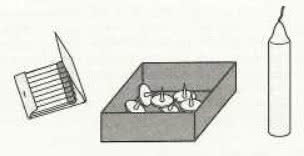
Your goal is to fix the candle to the wall so that wax doesn’t drip on the table. (You can give it a try before reading on).
One experimental group was promised a reward if their times were in the top 25% of research subjects. The other group received no reward.
Surprisingly, the reward group took 3.5 minutes longer to solve the puzzle. Getting paid more seemed to cloud their creativity.
By the way, here’s the suggested solution:

More examples of how rewards decrease creativity:
- Paintings that were commissioned were rated as less creative than non-commissioned works, despite being rated equally in technical quality.
- Artists who were surveyed as less extrinsically motivated achieved greater success in professional art, possibly because they had more internal drive to push through tough times where rewards didn’t come easily.
- Different funding styles lead to different rewards. The NIH evaluates projects independently, uses regimented controls like pre-defined deliverables and renewal policies. HHMI, on the other hand, awards investigators guaranteed support for 5 years, encouraging early failure and long-term success. HHMI investigators produce many more high-impact papers than their similarly-accomplished NIH counterparts.
- (Shortform note: this may suffer from the confound that HHMI is far more selective in its funding than the NIH (selecting only 20-30 researchers per year), and this may not be properly controlled for in the study.)
Rewards Decrease Good Behavior
People naturally want to do good things. Counter-intuitively, paying them for good behavior reduces their morality.
A study of Swedish blood donors found that paying people about $7 for each donation reduced the percentage of women who were willing to give blood to 30%, down from 52% in the control unpaid group. (Men were unaffected by pay.)
- Interestingly, a third group was given the option of donating the $7 to charity. Here the donation rate remained unchanged, at 53%.
- A related study found that giving blood donors a day off work increased donations.
What explains these effects? Donating blood is an inherently altruistic task, giving a “feeling that money can’t buy.” Removing barriers to altruism, like giving a day off, increased its success rate. But directly paying for it reduces internal motivation.
Rewards Give You More of What You Don’t Want
Rewards Increase Bad Behavior
In the inverse of the previous section, rewards can promote cheating. Rewards narrow focus to whatever it takes to get the reward, at the expense of the bigger picture.
Examples:
- Corporate scandals seem to be driven by short-term rewards – Enron cooked its books to meet short term revenue goals. (Shortform example: Wells Fargo imposed sales quotas and bonuses for opening accounts, and frontline workers were caught without customer permission)
- A classic study showed that when child care centers charged parents for picking up their child late, the delinquency rate increased. One explanation is that previously, parents were driven to treat the caretakers fairly, partly in return for caring for their precious children. But a fine reduced the relationship to a transactional level, where parents could now make a rational decision that the fine was worth their time in being late.
In contrast, intrinsic motivation views the task as a reward in itself. When the goal is to do one’s best and grow, it’s impossible to act unethically or chat, because the person you’ve disadvantaged is only yourself.
Rewards Create Addiction
Just like a drug, short-term rewards can induce a large effect initially, but two perversions happen over time: 1) people habituate to the reward and need more of it to induce behavior, and 2) when the reward is withdrawn, the intended behavior shuts off.
From a physiological standpoint, this is unsurprising, since task rewards trigger the same dopaminergic system that respond to drugs.
Like Tom Sawyer realized, giving a reward for doing something inherently signals that it’s an unpleasant task (people need to get paid to do this). And once you’ve given a reward to someone for doing something, there’s no going back – the person won’t agree to do the task unpaid from that point on.
Studies also show that activation in the brain’s nucleus accumbens, part of the dopaminergic system, increases risky choices and risk-seeking mistakes. This may partly explain why casinos give their participants rewards (free drinks, surprise gifts) to further spur risk-seeking in gambling.
Rewards Encourage Short-Term Thinking
Extrinsic rewards can narrow the focus of our decision making to short-term effects, ignoring long-term benefits.
Researchers found that public companies that devote more resources to quarterly earnings guidance deliver lower long-term growth rates. The causes are unclear but may include:
- Earnings-obsessed companies invest less in R&D, especially cutting R&D to avoid missing forecasts
- Companies that focus on short-term growth do so at the expense of long-term stability
- Companies that focus on quarterly earnings reports do so because they are already in ill health, and they want to continue building confidence
(Shortform note: contrast this with the company Amazon, which famously largely ignores quarter-to-quarter earnings to reinvest into further growth and market domination.)
This short-term thinking is important when rewarding people for activities that are ideally done over the long term, like education and personal health. If students get a prize for reading three books, they may focus more on the short-term reward and less on the benefit of long-term love of learning.
Exercise: Consider Your Motivation
Reflect on how rewards affect your behavior and motivation.
Have you ever done something purely for fun, then started getting paid for it? Describe the situation. How did getting paid change how you felt about the work, and how motivated you were?
Have external rewards ever pushed you to do something you were uncomfortable with? What was the situation, and how did the reward influence your behavior?
Think about the most fulfilling job or project you’ve worked on recently. What was so motivating about this? Why were you intrinsically motivated?
Chapter 2A: …and the Exceptions When Rewards Do Work
The author admits that rewards and punishments do work well in certain conditions.
First, workers need a secure baseline of compensation and work environment. If a worker is constantly anxious about how she’s going to put food on the table, she’ll find it hard to concentrate, no matter how enjoyable the task is.
Extrinsic Rewards for Routine Tasks
Next, extrinsic rewards work when the task at hand is routine and doesn’t involve creative thinking. Here, rewards don’t threaten intrinsic motivation because there is little intrinsic motivation to be undermined. Imagine doing a routine job on an assembly line.
You can make this work in your favor by promising rewards for work that is dull. For instance, if you need your team to pitch in on package shipping over the weekend, promise a party at the end.
Even better, supplement the reward with these three items:
- Explain why the task is important. Talk about the larger purpose of the work and how it helps achieve your organization’s mission.
- Acknowledge that the task is boring. This establishes empathy (“the boss knows what we’re going through”) and helps people understand this is the exception in your working relationship.
- Allow autonomy in completion of the task. When the task is boring, give people freedom in how exactly to execute the task.
Extrinsic Rewards for Non-Routine, Creative Tasks
Creative tasks are more likely to be driven by intrinsic motivation, which can be undermined by extrinsic rewards. The author gives a few ways to give rewards without dampening motivation:
- Try to avoid the “if-then” reward, where you announce beforehand that the reward is conditional on completion of the creative task. Instead, give an unexpected reward given after the task is finished. Because it’s unexpected, the reward is less likely to undermine intrinsic motivation while the task is being completed.
- Use nontangible rewards. Instead of cash, give positive feedback, which unlike money can actually increase intrinsic motivation.
- Provide useful feedback. Be specific and praise effort and strategy, rather than the outcome. For example, rather than saying, “great job, you completed the task like I said,” say “The initiative you took was inspiring, and I like your design choice here.”
All these rewards can increase employee happiness without dampening intrinsic motivation.
Chapter 3: Extrinsic vs Intrinsic Motivation
In the book we’ll discuss two types of behavior:
- Type X behavior is driven by extrinsic desires and less by the intrinsic satisfaction of an activity. This is Motivation 2.0.
- Type I behavior is driven by intrinsic desires – autonomy, mastery, and purpose. This is Motivation 3.0.
People tend to be driven primarily by either Type X or Type I. Consider yourself – what gets you up in the morning and pushes you through the day? What motivates that colleague that seems like a continuous go-getter?
Organizations also tend to be driven primarily by either Type X or Type I motivation. Picture a strict, commission-based salesforce running on Type X, while a free-working company like Google leans more Type I.
The book makes a few points about Type I behavior:
- Type I’s outperform Type X’s in the long term. While extrinsic rewards can fuel work in the short-term, they tend to exhaust as workers habituate to the reward. In contrast, intrinsic motivation can be self-sustaining and renewable over long periods of time.
- Type I behavior comes from both nature and nurture. Type I seems to be the natural state of most human beings (imagine the curiosity of a child), but Type X is forced upon us by the way we run our homes, our schools, and our workplaces.
- But there’s still hope - with education and the right environment, extrinsically motivated Type X’s can become intrinsically motivated Type I’s.
- Type I’s still care about money and recognition. You can’t expect Type I’s to work for free - they require a baseline compensation to remove money as a consideration point. But after a certain point, compensation is less a driver for Type I’s and more a form of recognition or feedback about performance.
- Type I’s have greater physical and mental health. Studies show that people who prefer autonomy and intrinsic motivation have higher psychological health and better relationships than Type X people. (Shortform note: It’s unclear whether this is correlation or causation. Healthier people may be in a better position to get more creative jobs that allow for more intrinsic motivation.)
Exercise: Type X or Type I?
Think about different scenarios where you’re more Type X or Type I.
Do you consider yourself more motivated by extrinsic rewards, or by intrinsic rewards? Describe why you believe this, maybe with a specific recent example.
Think about the environment in which you do most of your work, like your employer or school. Does this environment mainly emphasize extrinsic rewards or intrinsic rewards? How does this make you feel?
Chapter 4: Autonomy
So far, we’ve covered how the traditional reward/punishment system is limited in motivating today’s workers. But how do we replace Motivation 2.0?
With Motivation 3.0, which is focused on intrinsic rewards. In the next 3 chapters, we’ll go through the 3 main components of Motivation 3.0: Autonomy, Mastery, and Purpose.
Consider this thought experiment: would you rather be paid $75,000 to be an architect for the rest of your life, or $100,000 to be a toll booth operator for the rest of your life? If you choose the former, you’ve recognized that compensation isn’t everything. Being an architect gives you the autonomy, mastery, and purpose that is worth real value.
Autonomy
Autonomy is acting with internal choice. With autonomy, you have the ability to influence the work that you do and how you do it.
Autonomous motivation has been associated with good things: greater conceptual understanding, better grades, job satisfaction, higher productivity, less burnout, faster company growth, and better psychological health.
Autonomy is different from independence. Autonomy does not imply doing it alone and refusing the help of others. Instead, autonomy means acting through internal choice and not being driven by external pressure.
Why is autonomy so uncommon in today’s work environments? Historically, “management” has assumed the worst of people. “Left alone, workers get distracted and shirk their responsibilities. Without being told what to do, people will screw it up. Therefore, workers must be monitored and micromanaged.”
But Drive argues that humans are naturally wired to be self-driven. Look at infants and children – how many are not naturally curious, internally driven to explore the world without dangling rewards? Instead, we have our intrinsic motivation beaten out of us through rigid, paternalistic environments: home, school, and work.
To develop an intrinsically motivating environment, you need to allow people to rekindle their autonomy. Counter-intuitively, people who are given more freedom may be even more accountable for their work, not less (maybe because when given more trust and freedom, they don’t want to let their employer down).
For best results, people need to have autonomy over four major dimensions of their work: the task, the time, the technique, and the team.
Autonomy Over Tasks
In typical work environments, the entirety of what you work on is decided. Instead, people should enjoy some autonomy in choosing what they work on.
One common way to implement this is by giving 20% time to employees to work on any project they want. The only requirement is that the project should further the goals of the organization somehow.
In some cases, this has seemed to unleash employee creativity:
- In the mid-20th century, 3M gave technical staff 15% free time. Post-its arose from this free time.
- For much of its early history, Google gave 20% time to employees, leading to famous projects like Gmail, Orkut, and Google Translate.
- Georgetown University Hospital gives nurses autonomy to conduct personal research projects.
Companies that give 20% time believe it signals trust in their employees to do good things and stay efficient when the leash is taken off.
(Shortform note: in 2013 Google officially repealed 20% time. Employees found it difficult to truly spend 20% time on personal projects - those who worked more on company projects seemed to have higher performance reviews; managers put pressure on employees to work on official projects instead. This doesn’t mean it’s now a bad idea, but rather that it may have become inappropriate as Google matured.)
Another way to give autonomy over tasks is by holding a FedEx day, where workers are given freedom to work with a team on a project of their choice. The only restriction is that they must ship the project within a day (hence FedEx). These are also known as “hack days.”
Autonomy Over Time
Many work environments require facetime at the office during specific hours. Checking in late or leaving early are signs of negligence. Some workers are now expected to be available by text, email, or Slack around the clock. This leash crowds out personal time, reduces satisfaction, and increases turnover.
The antidote is a Results-Only Work Environment (ROWE), where the focus is on the work itself rather than when they do it. Workers still need to meet goals and deadlines, but as long as they achieve their goals, they can work whenever and wherever they want.
Some companies like Netflix have pushed the boundary even further, giving unlimited vacation days. (Shortform note: critics of unlimited vacation time argue it gives less guidance on what is acceptable and creates social pressure to take even less vacation than when the limits are clearly spelled out.)
Some work structures, like the legal billable hour, are so centered around time that ROWE seems hard to implement. But some legal firms are moving toward flat rate billing for projects, rather than a time-based fee.
Autonomy Over Technique
Even when workers doesn’t have full autonomy over what they do, they can still enjoy autonomy over how they do it. Work doesn’t need to be micromanaged – given goals to hit, people can figure out the best way to achieve them.
Examples:
- Zappos gives support staff freedom on how to serve the customer, doesn’t require scripts, and doesn’t monitor calls. This has famously led to some support calls lasting hours, with a very satisfied customer on the other end.
- JetBlue hires remote support staff and allows them to answer customer calls from home. This allows drawing from a deeper pool of talent, like parents, retirees, and people with disabilities.
(Shortform note: the book doesn’t go much further beyond support staff agents, but you can generalize this idea to most types of work. Make sure the worker understands the big picture – why it must be done, and what the desired result is – and trust that the worker will figure out the details herself.)
Autonomy Over Team
In most companies, you don’t get a choice of whom you work with. But this can lead to especially frustrating scenarios when you can’t stand certain teammates.
Some companies are experimenting with allowing people to choose their team:
- At Whole Foods, candidates work 30-day trials with a team, and the current employees decide whether to hire the person.
- At Facebook, new engineers spend 6 weeks in a coding boot camp. Then they interview with different teams and decide which to join.
- For 20% time and FedEx days, people can choose their own temporary groups to work with.
Across tasks, time, technique, and team, different people may have different preferences for how much of each type of autonomy they want. Some people may even want no autonomy for one or more of these. Try to match the best autonomy to each person.
Exercise: Get More Autonomy
Autonomy gives you more internal choice over what to do and how to do it.
Which of the four components of autonomy is most important to you? (Tasks, Time, Technique, or Team). How much autonomy do you get in this today?
Which of the four components of autonomy is least important to you? (Tasks, Time, Technique, or Team). Why does this matter less to you than the others?
How can you increase autonomy in your work? What’s a request you can make to your boss to increase your autonomy?
Chapter 5: Mastery
People naturally want to get better at skills and get recognized for their competency. This is mastery.
How is the pursuit of mastery beneficial? Mastery drives people to be more productive and more satisfied with their work. One study showed that in an engineering workplace, the desire for intellectual challenge was the best predictor of productivity. People who were extrinsically motivated worked just as hard, but they accomplished less, as defined by number of patents filed. And a survey of employees found that the greatest motivator is “making progress in one’s work.”
In your organization or life, you can promote mastery in these ways:
- Give goldilocks tasks that are neither too difficult (which provokes anxiety) nor too simple (with causes boredom). You want to challenge people right at the brink of their ability.
- Give people clear goals. A challenge that is out of reach for ability becomes even more anxiety-provoking when the worker isn’t sure what to do. By defining what should be achieved clearly, the worker can focus on how to achieve it.
- Provide fast feedback. Improvement requires understanding what you did well and how you can improve in the future. Fast feedback increases the iteration speed and rate of learning.
- Add more challenges to people’s jobs. Keep pushing people’s boundary of comfort to keep it interesting and give the feeling of growth.
These items form the foundation of deliberate practice, the efficient way to maximize growth within a period of time.
When challenged at the right level, people enter a state of flow – where the challenge is just right, the goal is just out of reach, and the task is so engaging that doing it is its own reward. People rate flow as the most satisfying experience in all of life, even moreso than leisure activities.
The book states there are three psychological components to Mastery.
1) Mastery Requires the Growth Mindset
Some people tend to believe that they’re born with the intelligence they have, and that people don’t get any smarter with work. “I’ve just never been any good at math and I never will be.” This is the fixed mindset you should avoid.
To successfully master something, you instead need to adopt the growth mindset – a belief that your intelligence and abilities are not fixed, that you have the potential to get better at whatever you want to.
People with different mindsets treat challenges differently:
- Fixed mindset people interpret failures as just confirming evidence that they’re not good at something. Growth mindset people interpret failures as feedback to use to get better.
- Fixed mindset people see effort as a negative sign that you’re not good at something – that’s why you need to struggle. Growth mindset people see effort as the way to get better.
- Fixed mindset people tend to set performance goals for themselves, like grades or promotions. Growth mindset people tend to set goals centered around progress and learning, with rewards coming as a natural consequence of mastery.
Education studies have shown that adopting the growth mindset in students leads to greater perseverance through difficulty and more creativity in novel challenges.
2) Mastery is Painful
Getting better is painful. There’s no way around it. People are born with different levels of talent, but without effort, this talent is wasted. And if you put in effort, you can exceed someone with greater natural talent who works less hard.
Mastery requires you to traverse failure and setbacks. You have to take incremental steps up, over and over again, consistently, day in and day out. If it were so easy, we’d all be masters of our craft.
There has been much recent writing on the quality of grit, or the combination of passion and perseverance. Grit allows you to persist through the setbacks to achieve the eventual goal of mastery.
3) Mastery is Never Achievable
A seeming paradox of mastery is that you can never fully reach mastery. Like an asymptote graph, you keep approaching it, inching forward, but the growth never stops.
Great athletes often say that they can always be better - that there’s no such thing as perfection. The journey never ends.
This can be frustrating, but it can also be continuously tantalizing. The next goal is always just out of reach, and you need to learn to enjoy the journey. This is why intrinsic motivation is more enduring than extrinsic rewards - while financial rewards might stop being attractive, a for desire mastery is never satiated.
Exercise: Aim to Achieve Mastery
The pursuit of mastery drives people to be more productive and more satisfied with their work. Try to improve your desire for mastery.
Do you have a skill that you wish to master? What is it, and what level of mastery do you want to achieve?
You achieve mastery faster through deliberate practice, which consists of 1) working on tasks that challenge you but aren’t too difficult, 2) having clear goals, 3) getting fast feedback on what you can improve. Whch of these are you most lacking today? What can you do to improve this in your future practice?
Chapter 6: Purpose
In addition to autonomy and mastery, the how and the what of work, the third pillar of Motivation 3.0 is the why of work. What purpose does the work serve? What is the value of what I’m doing? In particular, people are wired to want to help other people – it may be part of our evolution, selecting for people who do something beyond themselves.
In the absence of outward-looking purpose, people can become anxious or depressed. And if people blindly profit goals, at the expense of building meaningful relationships and achieving purpose, they may regret their emptiness when it’s far too late to change course.
Data suggests that today’s workforce is feeling an increasing need for purpose:
- Volunteerism rates are increasing rates, and this is correlated with increasing levels of worker disengagement. This suggests volunteering nourishes people in ways that today’s work does not.
- Workers rate nonmonetary factors like “giving back to society through work” as more important rewards than money.
- After the 2008 recession, a set of MBAs decided to institute an MBA Oath, centered around “serving the greater good by bringing people and resources together.”
Studies also show that acknowledging purpose makes people work harder and perform efficiently. In an experiment with university fundraisers, the group that was read stories about how raised funds benefited students worked harder and doubled the amount of money raised.
Here’s how to promote purpose in the workplace:
- When discussing goals of management, think beyond sterile words like “value” and “differentiation.” Reach for deeper ideals like honor, truth, justice, and beauty.
- Use the pronoun test to gauge your work environment – do people describe the company in terms of “we,” or in terms of “they?”
- Always explain why something needs to be done. This prevents work from feeling purposeless.
- Donate some company profits to charity, since spending money on others seems to increase our well-being. Even better, give employees autonomy over deciding where they want to send their share of the donation pool.
- Combine purpose with autonomy: give workers 20% time to work on a socially meaningful project.
Exercise: Increase Your Drive
Now that you understand the components of motivation, try to figure out how to increase yours.
Which one of the three components is weakest in your life: autonomy, mastery, and purpose? Why do you feel this way?
What is within your control to increase this in your life? How can you increase this intrinsic motivator?
Chapter 7: Tips to Increase Intrinsic Motivation
The book ends with a number of tips on achieving Type I intrinsically motivated behavior. We’ve grouped them into three categories:
- How to increase your own personal motivation
- How to increase motivation in your organization
- How to increase motivation with your children
Questions to Ask Yourself
Here are exercises to bring more Motivation 3.0 into your life and make necessary changes.
What is your sentence?
A congresswoman once told President JFK, “a great man is a sentence. Lincoln’s was: ‘he preserved the union and freed the slaves.’ FDR’s was: ‘he lifted us out of the Great Depression and helped us win a world war.’ What is your sentence?”
What is your sentence? What is the one thing you want to accomplish or be known for? You may need to reorganize your life to focus on this.
How did you get better today?
In pursuit of your sentence, you’ll need a lot of small tasks and setbacks. To keep yourself motivated, ask yourself at the end of the day: “are you better today than you were yesterday?”
Write down your small incremental steps, like learning 10 foreign words, or running two laps. Remind yourself you won’t be a master by day 3, and that mastery is a journey of a thousand steps.
Consider taking a sabbatical.
Many people work hard for 40 years, spending the final 25 years in retirement. But why not take retirement 5 years later than you otherwise would, and sprinkle 5 years of sabbatical throughout your career?
Taking a year off might give you valuable time for personal exploration and unstick you from the rat race.
Conduct deliberate practice.
The best way to improve is to apply effort toward improving performance. Don’t just blindly do the same thing over and over again. Conduct deliberate practice:
- Set a stretch goal. Remember that the goal of practice is to improve performance, not to go through the motions. You need to strain yourself to reach higher each time.
- Understand your weaknesses, and direct your effort there.
- Apply full concentration and effort. It’s going to be mentally and physically exhausting - but that’s why most people don’t do it, and that’s how you’ll get better.
- Receive immediate and informative feedback. This will point out how to improve.
- Repeat, with discipline. Mastery is the sum of thousands of small events, done day in and day out.
Improving Intrinsic Motivation In Your Organization
Here are strategies to improve autonomy, mastery, and purpose in your organization.
Give 20% Time for Self-Chosen Projects
If 20% time is too extreme of a transition, just start with 10% time, limited to a receptive small group of people.
Turn an Off-Site into a Fedex Day
Many off-sites fee like awkward forced-fun days. Instead, set aside the day for when employees can choose what to work on, with the only rule being that they must deliver. They can deliver a new idea, a prototype, a better process, or more.
Conduct Anonymous Surveys of Autonomy and Purpose
Ask questions like “how much autonomy do you have over your tasks at work” and “what is our organization’s purpose?” If you’re a manager, it’ll likely be surprising how inaccurately you perceive your workers to feel.
Give Yourself Performance Reviews
It’d be crazy to imagine an athlete like Lebron James getting feedback or coaching just once a year, in a 1-hour session. Try to seek more management feedback for yourself.
In addition, give yourself performance reviews. Set performance and learning goals at the beginning of the month, and then evaluate your performance at the end of the month.
Encourage Peer-to-Peer Rewards
Add a policy such that at any point, an employee can award any other employee a $50 bonus after doing good work. This has two benefits: 1) it avoids the flaws of contingent rewards and 2) it carries a different meaning coming from colleagues instead of from managers.
Involve Employees in Goal Setting
Bring employees into the goal-setting process. This will give them ownership over goals and make them feel more driven toward accomplishing them.
Design for the Majority of People who are Good, Not the Minority who are Bad
Many companies set policies to minimize downside – to prevent slackers from taking too much vacation or getting distracted when working at home. The problem is, people often naturally react to restrictions by pushing the limits of rules, looking for ways to game the system.
But if you’re hiring well, the majority of people should be behaving well, and the rest you should probably terminate. So design policies to assume trust by default. People will reciprocate the respect and trust they receive.
Introduce Changes Intelligently
If you’re an employee, you might feel powerless to change the entire scope of your company. Here are tips on how to achieve change:
- Start small. Think about how to make something in your domain better, tomorrow. Don’t worry about changing the whole company to be like Google overnight.
- Be subversive. Make a change without asking for permission. If it works out, tell others. If it doesn’t, then learn from the mistake silently.
- Emphasize results. To get management on your side, speak in their interest – tell them your changes will get results – better profits, higher sales.
Pay Fairly, Internally and Externally
The author believes monetary compensation is merely a baseline reward and isn’t inherently motivating. It just needs to be high enough so that people stop obsessing about how little they’re getting paid.
Internally, make sure that people are paid differently in a way that is publicly justifiable – based on seniority or complexity of work.
Externally, calibrate your compensation with local and industry averages. Pay more than average if you can - this will reduce retention and could be worth the extra cost in productivity (since employees won’t constantly be thinking about whether they can get paid elsewhere).
Question Whether Sales Commissions are Necessary
Consider paying employees who earn commissions with salaries instead. Here are benefits:
- You can stop spending time on constructing complicated, non-gameable commission schemes.
- Teamwork improves by reducing competition for commissions.
- Customers feel they’re receiving more earnest service by non-commissioned salespeople
Improving Your Children’s Intrinsic Motivation
Build Autonomy, Mastery, and Purpose Into Assignments
- Offer students autonomy over how and when to work.
- Promote mastery by giving a novel, engaging task, rather than just a regurgitation of something already covered.
- Help convey the purpose of the assignment and of the course itself. If they’re learning history, ask them to apply it to the news. If learning Spanish, take them to a local organization where they can practice it.
Give Kids Variants of Adult Employee Practices
- Allow a FedEx day where they can choose a project of their choosing.
- Have them set performance and learning goals for themselves. Run performance reviews just like with employees.
- Give feedback often, and make it specific.
- Praise effort and strategy, not intelligence. This will inspire the growth mindset and encourage pushing through future difficulties.
Don’t Combine Allowances With Chores
Tying chores to if-then rewards sends a message that chores are undesirable, and turns helping the family to a practical transactional. By requiring chores without pay, you build principles like teamwork and diligence.